Table of Contents
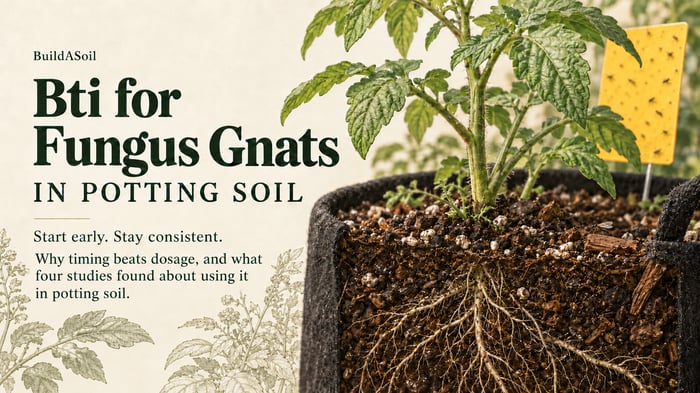
Bti for fungus gnats is backed by research going back to 1985: the same bacterium mosquito control programs have used since the late 1970s also kills fungus gnat larvae in potting soil. The research is clear on one thing most people miss: it works as a prevention program, not a one-time rescue.
If you grow indoors, you have met fungus gnats. The adults flying around your face are a nuisance, but they are not the problem. The problem is the larvae living in the top inch or two of moist soil. They feed on fungi and decaying organic matter, and they will also feed on healthy roots and tunnel into young seedlings and cuttings, which leads to wilting and stunted growth (Cloyd 2015).
Below is everything you need to know about Bti for fungus gnats: what it is, why it works, what four studies actually found, and how to use it so it works.
How Bti works
Bti for fungus gnats only works when a larva eats it. Bti is short for Bacillus thuringiensis subspecies israelensis, a soil bacterium first reported as a mosquito larvicide in 1977. It makes protein crystals that do nothing until they are swallowed (Ben-Dov 2014).
- A larva eats the crystals along with whatever it is feeding on.
- The larva's alkaline gut dissolves the crystals, and its own gut enzymes turn them into active toxins.
- The toxins lock onto receptors on the gut wall.
- They punch holes in the gut cells. The cells swell and burst, the larva stops feeding, and it dies (Silva-Filha et al. 2021).
Mosquitoes and fungus gnats are close relatives. Both belong to the Nematocera, an old group of flies whose larvae share the gut chemistry and receptors Bti needs. That is why EPA describes Bti's toxins as targeting the larvae of mosquitoes, black flies and fungus gnats (EPA).
Two things follow when you use Bti for fungus gnats:
- Adult gnats are not affected. Only feeding larvae are. The adults you already have will keep flying until they die off on their own.
- Not all Bt is the same. Bt kurstaki, the caterpillar strain sold for cabbage worms, had little effect on fungus gnats in two separate studies. Make sure the label says israelensis.
What the research shows
The research on Bti for fungus gnats is consistent: it kills young larvae reliably, struggles with older ones, and works in real pots only when applied repeatedly.
| Study | Setting | What happened |
|---|---|---|
| Duarte et al. 2023 | Lab, then potted strawberries | 92% larval mortality in the lab. Only 26% fewer adults emerged from treated pots. |
| Cloyd and Dickinson 2006 | Potting mix, one drench, 2nd and 3rd instar larvae | No measurable effect on either larval stage. |
| Osborne et al. 1985, greenhouse | Potted plants, 3 drenches over about 2.5 weeks | No change at week 1. By week 3, larvae dropped from 2.5 per pot to as low as 0.08, matching a chemical insecticide. |
| Osborne et al. 1985, lab | Larvae on agar plates | 92% mortality when exposed from egg to pupa. Older larvae took far higher doses. |
Osborne, Boucias and Lindquist (1985) was the first published test of Bti on fungus gnats. In the lab, affected larvae went limp within 24 hours and had broken down by 48 hours. Larvae that survived developed much more slowly: at the highest dose, every survivor was still a larva on day 8, while 85.5% of untreated larvae had already become pupae or adults. The authors concluded that younger larvae are far more susceptible than the oldest ones.
Cloyd and Dickinson (2006) is the study people leave out. They drenched commercial potting mix holding second and third instar larvae with two Gnatrol formulations at light and heavy rates. Bti did nothing measurable to either stage, while several synthetic insecticides worked. Their conclusion: growers using Bti "must make applications before fungus gnat populations build up and before overlapping generations develop."
Duarte and colleagues (2023) found the same gap between lab and pot. Bti was the only one of four Bacillus strains that worked, with 92% mortality in the lab, but it cut adult emergence by only 26% in potted strawberries.
Kansas State University extension guidance sums it up: Bti is more effective on first and second instars than on third and fourth instars (Cloyd, K-State MF-2937).
Why timing matters
Bti for fungus gnats works by catching each new batch of larvae while they are young, so it has to be in the soil before and during an outbreak, not after one is established.
- Young larvae are the target. Osborne's 9-day-old larvae were already in their last larval stage, and they took the highest doses. Newly hatched larvae die easily.
- One application is not enough. An established gnat population has eggs, larvae of every age, pupae and adults all at once. One drench catches only the youngest larvae present that day. Repeat applications catch each new hatch as it comes.
- Expect a slow start. In Osborne's greenhouse trial, nothing changed in the first week. The big drop came by week three, after three drenches.
- Start at the first gnat. One or two adults on a sticky card means eggs are already in the soil. That is the moment to start, not when the cards are covered.
- Bti for fungus gnats fits prevention best. Bti treatments are often applied regularly at lower rates to keep populations from building in the first place.
How to use Bti for fungus gnats in potting soil
When using Bti for fungus gnats, choose a product whose label lists fungus gnats in potting soil or growing media, and follow that label exactly. Bti products are registered pesticides, and each one has its own approved uses, rates and directions. Many Bti products are labeled only for mosquitoes in standing water.
As an example, here is what the home-use label for Summit Mosquito Bits (EPA Reg. No. 6218-86) says for fungus gnats in the soil of house, garden and landscape plants (EPA label):
- Small pots, 6 inches or less: 1 to 2 teaspoons per pot.
- Large pots, over 6 inches: 1 tablespoon per pot.
- Beds and larger areas: 1 tablespoon per square foot of soil.
- Water it in after applying.
- Or treat your water: mix 2 tablespoons in half a gallon of water, wait 5 minutes, then pour the treated water onto the soil surface.
- Repeat if gnats return within 3 weeks. The label states control lasts up to 3 weeks.
Commercial greenhouse products such as Gnatrol WDG and AquaBac fg are applied as a liquid drench. Their fungus gnat directions are written for commercial greenhouse and nursery use, so home growers should stick to a product labeled for home use.
A few practical points that hold for any labeled product:
- Treat every pot in the area, not just the one where you saw gnats. Adults move between pots.
- Get it into the top inch or two of soil, where the larvae live and feed.
- Read the label before each use. Rates and repeat intervals differ between products.
A complete fungus gnat plan
Bti for fungus gnats handles the larvae, but gnats come from wet soil, so the plan starts with water.
- Let the top of the soil dry between waterings. Fungus gnats are mainly a problem under excessive moisture. Well-drained soil and not overwatering are the foundation of control (Cloyd 2015).
- Put out yellow sticky cards. They catch adults and tell you whether the numbers are going up or down.
- Start a labeled Bti product at the first sign of gnats. Repeat on the label's schedule for 3 to 4 weeks to cover overlapping generations.
- Clean up. Remove dead leaves and plant debris from the soil surface, and keep spare potting soil sealed. Adults can emerge from discarded soil and move onto your plants.
- Skip sand or diatomaceous earth on top. Research found these layers did not reduce adult emergence or egg-laying, because larvae and egg-laying females get through the gaps (Cloyd 2015).
What to expect from Bti for fungus gnats: little visible change in week one, fewer adults on the cards by week two, and a sharp drop by week three. Keep the soil surface drier after that, and the cycle is hard for gnats to restart.
Add predators to the soil
Bti for fungus gnats covers the larvae for a few weeks at a time. Living predators in the top layer of soil keep working between applications. Cloyd's 2015 review lists three that have been shown to help keep fungus gnat populations in check (Cloyd 2015):
- Stratiolaelaps scimitus (formerly Hypoaspis miles), a predatory mite that lives in the top layer of soil.
- Dalotia coriaria, a soil-dwelling rove beetle.
- Steinernema feltiae, a beneficial nematode applied in water.
All three come in our small, medium and large beneficial insect combo packs. In a living soil, a standing population of predators fits the way we grow anyway.
References
- Osborne, L.S., Boucias, D.G. and Lindquist, R.K. (1985). Activity of Bacillus thuringiensis var. israelensis on Bradysia coprophila (Diptera: Sciaridae). Journal of Economic Entomology 78(4): 922 to 925.
- Cloyd, R.A. and Dickinson, A. (2006). Effect of Bacillus thuringiensis subsp. israelensis and neonicotinoid insecticides on the fungus gnat Bradysia sp. nr. coprophila. Pest Management Science 62: 171 to 177.
- Duarte, A. da F. et al. (2023). Toxicity of Bacillus sp. on the fungus gnats, Bradysia aff. ocellaris larvae. Bioscience Journal 39: e39089.
- Cloyd, R.A. (2015). Ecology of Fungus Gnats (Bradysia spp.) in Greenhouse Production Systems Associated with Disease-Interactions and Alternative Management Strategies. Insects 6(2): 325 to 332. PDF (open access, CC BY 4.0).
- Cloyd, R.A. Fungus Gnat Management in Greenhouses and Nurseries. Kansas State University Extension, MF-2937.
- Ben-Dov, E. (2014). Bacillus thuringiensis subsp. israelensis and Its Dipteran-Specific Toxins. Toxins 6(4): 1222 to 1243.
- Silva-Filha, M.H.N.L. et al. (2021). Bacterial Toxins Active against Mosquitoes: Mode of Action and Resistance. Toxins 13(8): 523.
- Lacey, L.A. (2007). Bacillus thuringiensis serovariety israelensis and Bacillus sphaericus for mosquito control. Journal of the American Mosquito Control Association 23: 133 to 163.
- U.S. EPA. Bti for Mosquito Control.
- U.S. EPA. Mosquito Bits label, EPA Reg. No. 6218-86.
Beneficial Insect Combo Packs (Small)
$121.00
All Beneficial Insect Combo Packs come with Free Shipping! Please check the next tabs for more information on any of the insects offered in the combo packs. NOT AVAILABLE FOR CANADA CUSTOMERS!!!!! Notice: Beneficial Insects ship out immediately, within 1-7… read more

FAQs
Does Bti kill adult fungus gnats?
No. Bti only affects larvae that eat it. Adults already flying will die off on their own over the following days, so use yellow sticky cards to catch them in the meantime.
How long does Bti take to work on fungus gnats?
Expect little change in the first week. In the original 1985 greenhouse study, larvae dropped sharply by week three after three applications.
Why didn’t one application of Bti fix my gnat problem?
One application only reaches the young larvae present that day. Older larvae are much harder to kill, and eggs keep hatching. Repeat on the label’s schedule for 3 to 4 weeks.
Is Bt the same as Bti?
No. Bt kurstaki is the caterpillar strain and had little effect on fungus gnats in research. For gnats, the label should say israelensis and list fungus gnats as a target.
Can I use any Bti product for fungus gnats?
All Bti products use the same bacterium, but they differ in strain, strength and form, and each label sets its own approved uses and rates. For fungus gnats, choose one whose label lists fungus gnats in potting soil or growing media, and follow its directions.
Did Bti hurt the plants in the research?
The 1985 greenhouse study reported no plant damage from any of the Bti treatments.