Table of Contents
- Rootwise Deep Dive, How to Use It, When to Apply It, and Why It Actually Works in Living Soil
- Why Most Growers Overcomplicate Microbes
- What Makes the Rootwise System Different
- Understanding Mycrobe Complete, Building the Network
- Understanding Bio-Catalyst, Driving the Soil System
- Understanding Bio-Phos, Supporting the Flowering Transition
- Rootwise Application Timing, Step by Step
- Stop Wasting Microbes, Smarter Application Methods
- Does Mycorrhizae Actually Work in Potting Soil?
- If Living Soil Already Has Microbes, Why Use More
- Why Some Microbial Products Don't Work
- Why Labeling and Sourcing Create So Much Confusion
- Rootwise Is Built on Trust and Verification
- Why Mixing Multiple Inoculants Can Backfire
- Final Thoughts, Build the System Not the Inputs
- FAQs
Rootwise Deep Dive and Application Timing
Rootwise Deep Dive, How to Use It, When to Apply It, and Why It Actually Works in Living Soil
Why Most Growers Overcomplicate Microbes
Before I started using Rootwise, I used several other brands. I even mixed them together. One of the most common things I see when growers start getting into microbes is they go all in right away. They hear that biology is important, which it is, and then they start grabbing multiple products off the shelf, mixing brands together, and applying everything all the time. It usually comes from a good place, they want to do it right, but it often turns into redundancy and extra expense.
The assumption is that more biology must mean better results, but that's not really how this works. A lot of these products contain overlapping species, so you end up doubling or tripling up on the same organisms without even realizing it. On top of that, microbes compete with each other. When you overload the system, especially with aggressive organisms, you can actually create imbalance instead of improving diversity. In a lot of cases you're just spending more money without gaining anything meaningful.
If you really want to learn how to use microbes, you have to step back and look at function and timing instead of just adding more. That's where something like Rootwise stands out, and honestly why it's one of the few microbial systems that actually makes sense to me when I look at it from a living soil perspective.
What Makes the Rootwise System Different
This isn't just a random collection of products. It's built as a system that follows the plant through its lifecycle. Each piece has a role, and more importantly, each piece has a time when it actually makes sense to use it. That alone is a big shift compared to how most growers are using microbial inputs.
At the center of everything is Mycrobe Complete. If you were only going to use one product, this would be it. This is your foundation inoculant, and it's doing the heavy lifting early on. You're introducing mycorrhizal fungi along with a broad consortium of beneficial bacteria and fungi that help establish the biology in your soil. This is where the relationship between the plant and the soil really starts to develop.
Understanding Mycrobe Complete, Building the Network
The mycorrhizae are especially important here because they are not just another microbe in the mix. They actually form a direct relationship with the plant roots. As the roots grow, the fungi extend outward into the soil, increasing the plant's ability to access water and nutrients. That relationship takes time to build, which is why applying early, during root establishment and vegetative growth, matters so much. You're not just getting a short-term effect, you're setting up a network that can continue working throughout the entire cycle.
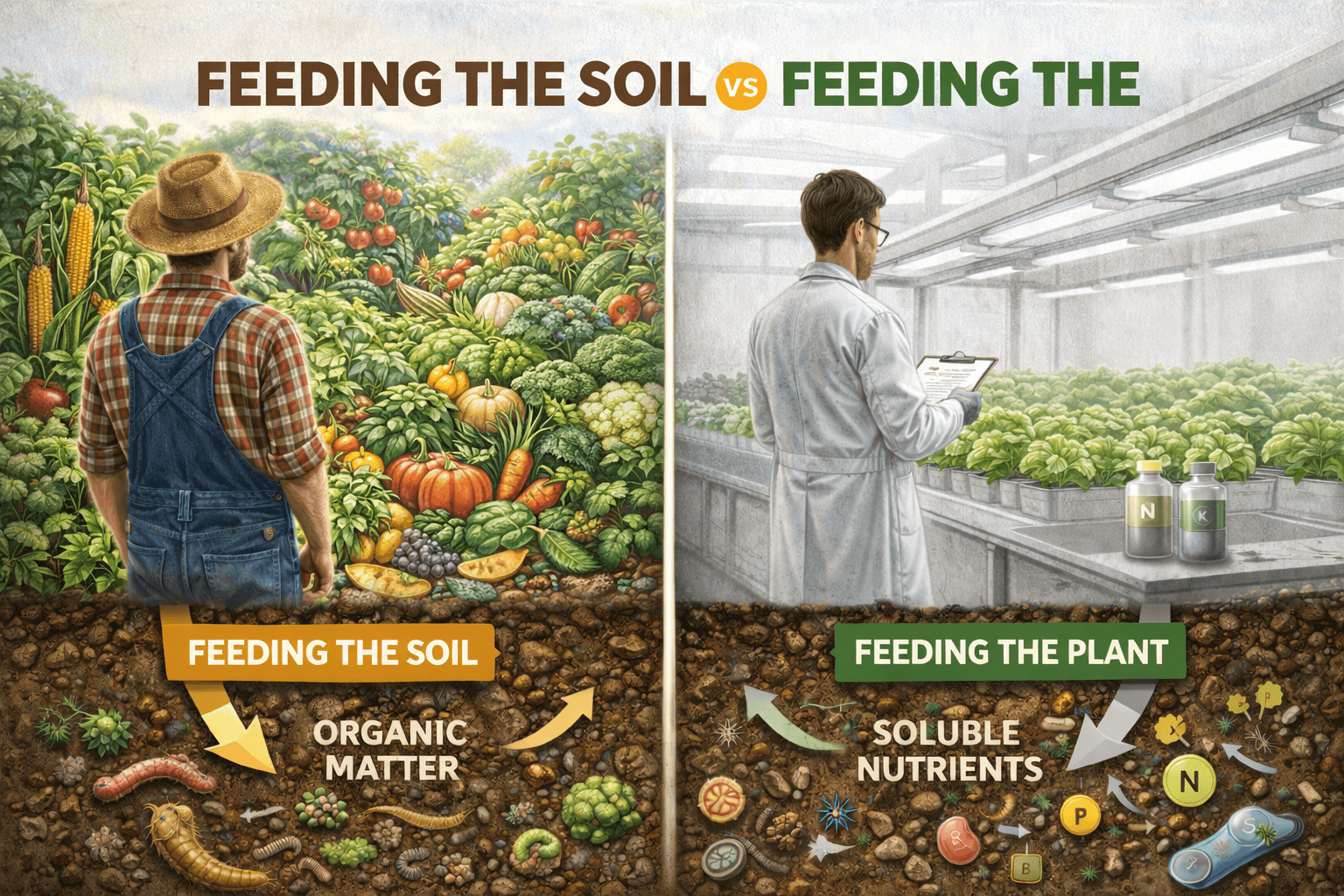
Alongside that, you have all the other biology working on breaking down organic matter and cycling nutrients into forms the plant can use. That's really what living soil is all about. It's not about feeding the plant directly, it's about building a system that feeds the plant.
Understanding Bio-Catalyst, Driving the Soil System
Then you bring in Bio-Catalyst, which is one of the more interesting parts of the system because it's not another inoculant. It's not adding more organisms, it's helping the ones you already have work more efficiently. In a living soil system, nutrients are tied up in organic matter and need to be broken down before they become available. That process is driven by microbes, and Bio-Catalyst helps accelerate that process by stimulating microbial activity and enzyme function.
This becomes more important the longer you run your soil. As you top dress and reuse your soil, organic matter builds up. Without strong biological activity, that material can sit there and break down slowly. When the system is working well, that breakdown is happening continuously and nutrients are being released in a steady, plant-available way. That's what you're supporting with something like Bio-Catalyst.
Understanding Bio-Phos, Supporting the Flowering Transition
Then when you move toward flowering, things shift. The plant's needs change, and instead of continuing to apply Mycrobe Complete over and over, you transition into Bio-Phos. This is one of the most important pieces that people overlook. They assume they should just keep adding mycorrhizae, but at that point the relationship is already established. What the plant needs now is support for the processes involved in flowering, especially around phosphorus cycling and energy transfer.
So instead of reapplying the same biology, you're shifting to biology that mobilizes the Phosphorus in your soil, supporting the flower phase of your program. That's a big difference, and it's one of the reasons this system is more efficient. You're not wasting inputs, you're using them with intention.
Rootwise Application Timing, Step by Step
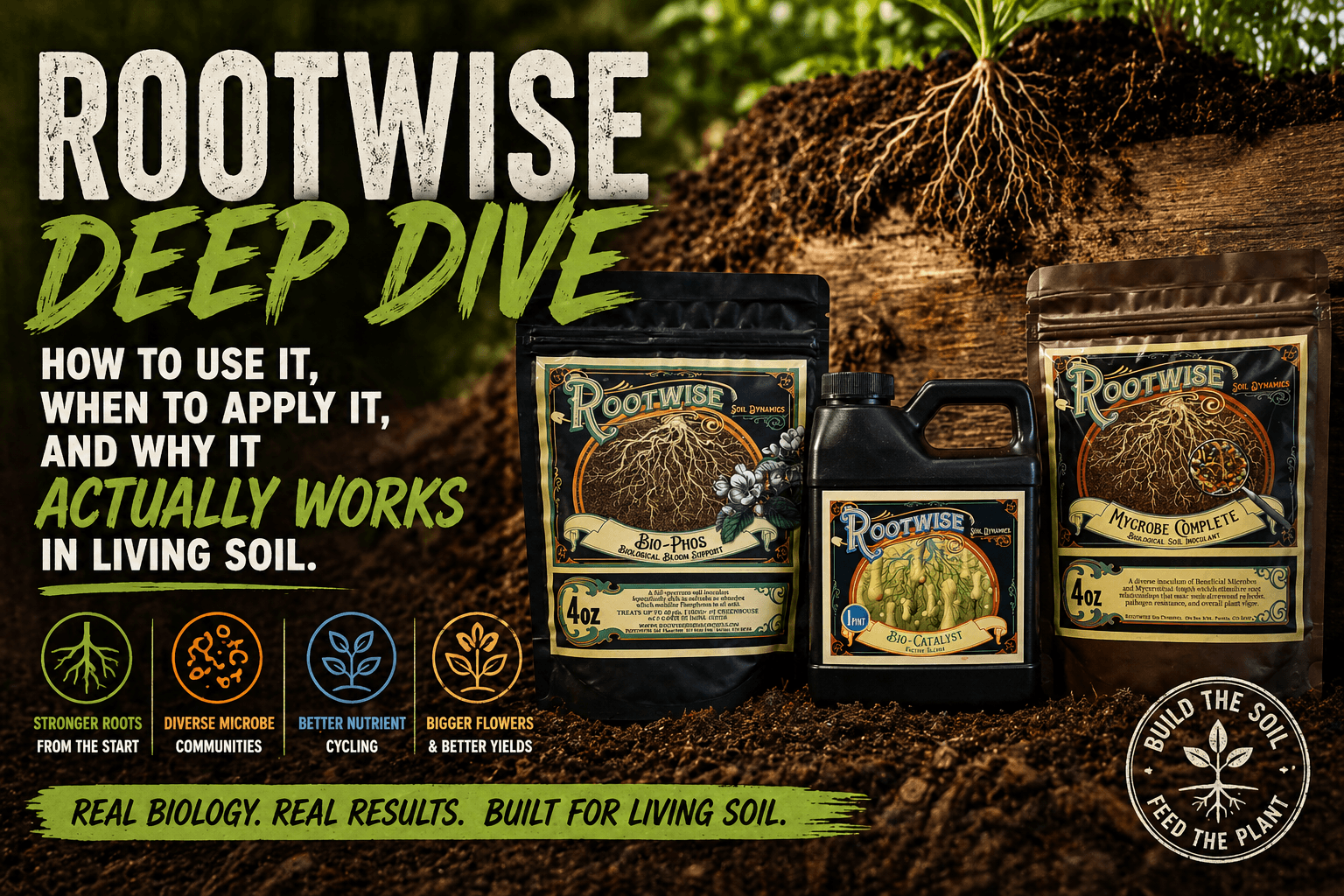
When you lay it out simply, the timing looks like this. You start with Mycrobe Complete from early root development through vegetative growth, applying about every two weeks and always using it when you transplant. About a week before flipping to flower, you do a transitional application using both Mycrobe Complete and Bio-Phos together with Bio-Catalyst. Then once you're into flower, you switch fully to Bio-Phos and Bio-Catalyst, applying weekly for the first few weeks, then backing off to every couple weeks until your final application about two weeks before harvest.
That's the structure, but how you apply it matters just as much as when you apply it.
Rootwise Application Timing Quick Reference
| Growth Stage | Products to Use | Frequency | Purpose |
|---|---|---|---|
| Early root development & veg | Mycrobe Complete | Every 2 weeks + at every transplant | Establish mycorrhizal network and soil biology |
| ~1 week before flip to flower | Mycrobe Complete + Bio-Phos + Bio-Catalyst | Single transitional application | Bridge from veg biology to flower biology |
| Early flower (first few weeks) | Bio-Phos + Bio-Catalyst | Weekly | Mobilize phosphorus and drive nutrient cycling |
| Mid to late flower | Bio-Phos + Bio-Catalyst | Every 2 weeks | Sustain microbial activity and P availability |
| ~2 weeks before harvest | Bio-Phos + Bio-Catalyst | Final application | Last push of nutrient cycling support |
For a quick visual breakdown straight from the source, check out this post from Rootwise answering exactly how to use the Combo Pack and whether the three products should be mixed together.
Stop Wasting Microbes, Smarter Application Methods
Most microbial products are designed around the idea that you mix a full dose into your irrigation water every time you water. That might make sense in certain systems, but in living soil it can be pretty wasteful. Once your biology is established, you don't need to keep saturating the entire container with microbes. They are not fertilizers. They don't need to be reapplied constantly.
A better way to think about it is in terms of placement and efficiency. When you are first establishing biology or after a transplant, it makes sense to apply enough solution to treat the soil volume. But outside of that, you can be much more targeted. You can water normally, then come back with a smaller amount of inoculant and apply it directly to the root zone. That's where the biology is actually interacting with the plant. Mycorrhizae operate in the rhizosphere, not evenly across every inch of soil. Once you understand that, it becomes obvious that you can use less and get better results by placing it where it matters.
Does Mycorrhizae Actually Work in Potting Soil?
This ties into another question that comes up a lot. You will hear people say that mycorrhizae doesn't work in pots. The truth is that it depends entirely on the system. In sterile media or high input systems, the plant does not rely on fungi, so the relationship never develops. But in living organic soil, especially reused container soil, it works extremely well.
Nutrients are tied up in organic matter and need to be cycled. That is exactly what microbes and fungi are designed to do. So the real question is not whether it works in pots, it is what kind of system you are running.
If Living Soil Already Has Microbes, Why Use More
This is another fair question. If your compost is high quality, your soil already contains a lot of life. So why add anything at all. The answer is not that you need more microbes, it's that you can guide the system.
Compost gives you diversity, but it doesn't always give you specific function. It may not contain strong mycorrhizal populations, and even if it does, those organisms are not always active when the plant needs them. Targeted inputs help reinforce those relationships and make sure they are active at the right time.
There is also the reality of containers. In field systems, biology stabilizes over years. In containers, everything is compressed. Reinforcement helps maintain balance.
And something newer growers may not realize is how inconsistent things used to be. Before high quality biological inputs were widely available, pathogens and weak soil biology were much more common. Now we have tools that help beneficial organisms outcompete undesirable ones and establish strong systems early.
Why Some Microbial Products Don't Work
This is where the conversation gets more nuanced, and honestly where a lot of the skepticism in the industry comes from. You will hear people say microbial products don't work, or that mycorrhizae is overhyped, and that didn't come out of nowhere. There are real studies backing up those concerns, but the details matter.
A large meta-analysis that looked at over 250 commercial mycorrhizal product trials found that most of them resulted in very low levels of root colonization, often under 10 percent. Even more telling, around 84 percent of the products showed little to no meaningful fungal activity, and only about one in nine actually delivered both strong plant growth and real mycorrhizal colonization.
That is a pretty big deal, but it does not mean the biology itself doesn't work. What it shows is that many commercial products are not delivering viable, functioning microbes in a way that actually establishes in the soil.
There are a few common reasons for that. In some cases, the microbes in the product are simply not alive by the time they reach the grower. Storage, shipping, and shelf life all matter, and biology is not something that handles poor conditions well. In other cases, the species listed on the label may not be present in meaningful amounts, or at all. There are also situations where products appear to improve plant growth, but not because of microbial colonization. Some contain added nutrients or carrier materials that give a short-term boost, even if the biology itself never establishes.
One of the more interesting findings in that research is that some commercial products increased plant growth even when there was little to no mycorrhizal colonization. That suggests the benefit was coming from something else entirely, not the fungal relationship the product was supposed to provide. At the same time, when researchers compared those products to laboratory-grown inoculants or field-derived biology, the difference was clear. When the microbes were viable, properly handled, and actually capable of colonizing roots, the results were much more consistent.
Another important takeaway is that label claims do not guarantee performance. High spore counts look good on paper, but if those propagules are not viable, they do nothing. The research showed that even products with very high labeled counts often had the same poor colonization as products with much lower counts, which points back to viability being the real issue.
So when growers say they tried microbes and didn't see a result, that experience can be completely valid. But what they are often reacting to is a product quality problem, not a failure of the biology itself.
The real takeaway from these studies is not that microbial inputs don't work. It's that quality control, sourcing, and handling matter more than most people realize. When you have viable, verified biology and you use it in a system that actually supports it, the relationship works the way it's supposed to. When you don't, it can look like the whole concept is flawed.
A big part of the problem comes down to sourcing, and this is something most customers never really see.
A lot of products in this space are not built by people deeply involved in soil biology. Many are trend-driven, where someone imports microbes from overseas, puts a label on it, and sells it without really understanding it.
There is also very little regulation around this, so transparency and verification can be inconsistent. That makes it difficult for growers to know what they are actually getting.
Then on top of that, to register in each state, most do not recognize the microbes and the label ingredients
On the other side of that, working with verified biology in the United States is not simple. There are not many labs doing this at a high level, and sourcing, identifying, and cultivating real, indigenous microorganisms takes time and expertise.
That's part of why we work closely with Rootwise the way we do. At BuildASoil, we only bring in about a 30 to 60 day supply at a time and move it quickly so it stays fresh. Even though Rootwise is a stable powder inoculant that can last for years when stored properly, we still prioritize turnover and proper handling so you are getting it in its best condition.
When you combine known sourcing, proper storage, and fast inventory movement, it removes a lot of the uncertainty that exists in this category. And in a space where viability is everything, that matters more than most people realize.
Why Labeling and Sourcing Create So Much Confusion
A big part of the confusion around microbial products comes down to sourcing and labeling, and most customers never really see what's happening behind the scenes.
There is some risk with overseas products, especially when biology is shipped long distances and handled under unknown conditions. These are living organisms, and viability can drop off depending on storage, heat, and time. By the time something makes it through production, shipping, warehousing, and onto a shelf, there can be a lot of unknowns.
But even beyond that, one of the biggest issues in this space is labeling, especially in the United States.
Every state has different rules when it comes to registering biological products, and those rules are not always aligned. Some states allow companies to list a broader range of organisms based on what is known to be in the product, while others are much more restrictive and only allow specific, verified claims. Because of that, companies are often forced to simplify or reduce what they list on the label just to be able to register and sell across multiple states.
That creates a situation where the label does not always reflect the full biology of the product.
A good example of this is something like EM-1, which is commonly labeled as containing lactobacillus, even though it is widely understood to also include yeast and photosynthetic bacteria. The label is not necessarily wrong, it is just limited by what is allowed to be claimed.
So when growers compare products based on labels alone, it can be misleading. One product may look simple, another may look complex, but neither label really tells you how viable the biology is, how it was sourced, or how it will actually perform in your soil.
This is part of why trust and transparency matter so much in this category.
And it's also why systems like Rootwise stand out. Instead of trying to piece together different products from different companies, each with their own sourcing, labeling limitations, and unknown compatibility, Rootwise is designed as a complete system. Each product has a clear role, a specific timing, and they are built to work together across the entire plant cycle.
That removes a lot of the guesswork.
You are not stacking random biology and hoping it all plays nice. You are following a system that was designed from the start to be used together, which is a completely different approach than mixing and matching products that were never intended to interact.
Rootwise Is Built on Trust and Verification
Rootwise takes a very different approach when it comes to sourcing biology, and that's a big part of why it performs the way it does.
Behind the scenes, the microbial blends are developed in partnership with a long-standing, family-run microbiology lab here in the United States that has been working with beneficial organisms for over 35 years. This isn't a new company jumping into a trend. It's a group that has spent decades studying, isolating, and working with microbes in real agricultural systems, not just in theory.
One of the key differences is their focus on diversity and balance. Instead of building products around one or two isolated strains, the goal is to create balanced microbial communities that function more like what you would find in nature. That matters because in soil, it's not about a single organism doing one job, it's about how groups of organisms work together.
There is also a strong emphasis on quality and consistency. Each batch is produced under controlled conditions and independently tested before it ever leaves the facility. That includes verifying microbial counts and ensuring there are no unwanted contaminants. In a space where a lot of products are inconsistent, that level of verification matters.
And this isn't just lab theory. These types of microbial systems have been tested in real-world conditions. In one example, Utah State University evaluated multiple biostimulants on a crop grown in very dry conditions. Out of several products tested, this type of biology was the only one that out-yielded the control and also produced the best overall size in the trial. That kind of result speaks to function, not just claims.
At the end of the day, none of this works if the biology isn't viable, properly identified, and handled with care from start to finish. That's the piece that often gets overlooked, and it's what separates something built on real microbiology from something that's just packaged and sold.
Why Mixing Multiple Inoculants Can Backfire
Mixing different microbial products sounds like it would increase diversity, but in practice it often does the opposite.
A lot of products on the market are built around very narrow functions. You'll see one that's mostly Bacillus, another focused on Trichoderma, something labeled as mycorrhizae, and maybe another built around lactobacillus or fermented inputs. On paper it feels like you're stacking diversity, but in reality you're often just overlapping functions or doubling up on similar organisms without realizing it.
It gets even more confusing when you look at labels. Because of how products have to be registered across different states, companies are often forced to simplify what they list. That means you might not actually know the full biology in each product, and when you start mixing multiple brands, you can unknowingly stack the same species over and over. At that point you're not increasing diversity, you're skewing the balance.
And balance matters more than people think.
Microbes compete for space, food, and dominance in the soil. Certain organisms, especially aggressive ones like some Trichoderma strains, can take over quickly and suppress other beneficial microbes you actually want working in your system. Instead of building a cooperative soil food web, you can end up with a few dominant players that limit overall function.
There's also the issue of mismatch. Not all microbes are meant to work together, and not all are suited for the same type of growing. A good example is the common use of endo and ecto mycorrhizae blends. Those mixes are designed more for mixed species environments like forests or perennial systems. For fast-growing annual flowering plants, you're really relying on specific endomycorrhizal relationships, so throwing in everything just to have more names on the label doesn't necessarily improve performance.
Then there's the simple reality of cost.
A lot of growers end up spending a significant amount of money stacking multiple products, thinking they are building something more complete, when in reality they are just creating redundancy. You might be paying for the same function three different times without realizing it.
And this is something you even see at the highest levels. There are growers out there winning competitions and setting records who are sponsored by multiple companies, so they run a wide range of products. But if you actually pay attention, many of them still rely on one core biological system that they trust, regardless of what else they are required to use. That tells you something.
The takeaway here is not that individual products are bad. It's that randomness is the problem.
Instead of stacking isolated inputs and hoping they work together, it makes more sense to use a system that was designed to be balanced from the start. Something where the biology is already working in synergy, where each piece has a role, and where you're not guessing about compatibility.
That's where you stop wasting money and start building a soil that actually functions the way it's supposed to.
Final Thoughts, Build the System Not the Inputs
When you step back and look at all of this, it really comes down to a simple shift in thinking.
This isn't about chasing the next input or stacking more products. It's about building a system that actually works, one that gets better over time instead of needing to be constantly corrected.
Good compost gives you the foundation. From there, it's about reinforcing the right biology, at the right time, in a way that supports the plant instead of overwhelming the soil.
That's where a system like Rootwise really makes sense.
You're not guessing what to mix. You're not stacking random products and hoping they don't compete. You're not wasting money reapplying the same function over and over. You're following a structure that was designed to work with the plant from early root development all the way through flower.
Mycrobe Complete helps establish the relationships that everything else depends on. Bio-Catalyst keeps that system active and cycling. Bio-Phos steps in when the plant shifts into its most demanding phase. It's not more inputs, it's better timing and better function.
And that's really the difference.
If your soil is already dialed, you might not need much. But for most growers, especially those trying to build consistency or improve over multiple cycles, having a reliable biological system in place removes a lot of the guesswork.
At a certain point, you stop asking "what else should I add" and start seeing the soil do more of the work for you.
That's when things get easier… That's when it clicks…
Now you're not chasing results anymore, you're building a soil that consistently produces them, and supporting it with a system that actually makes sense. So go ahead and grab some Rootwise and put it to work in your next run. And if you're already using it, now you know exactly why it's something you stick with.
Rootwise Combo Pack - 3 Product Bundle
$99.90
$111.00
Three products, one program, veg through flower. Mycrobe Complete builds the root network. Bio-Phos takes over for flower. The Bio-Catalyst enzymes run the whole way through. Buy them together and the bundle comes in at 10% off the three separately,… read more

Rootwise Mycrobe Complete
$30.00
Mycrobe Complete is a dry, full-spectrum soil inoculant. Twenty species of beneficial bacteria, mycorrhizae, and fungi in one bag. You mix a very small dose into water and drench the root zone, whether you are firing up a brand new… read more

Rootwise Bio-Catalyst Enzyme Elixer
$36.00
Bio-Catalyst is not an inoculant, and that is the point. You are not buying it for a population of organisms. You are buying it for the enzymes: ten of them, exuded by non-GMO beneficial bacteria, yeast, and fungi cultures, then… read more

Rootwise Bio-Phos - Biological Bloom Support
$45.00
Bio-Phos is the flower half of the Rootwise system. Sixteen species of beneficial bacteria, weighted hard toward the organisms that mobilize phosphorus. It does not add phosphorus to your soil. It unlocks the phosphorus your soil already has and cannot… read more

FAQs
What is Rootwise and what products are included in the system?
Rootwise is a microbial system designed for living soil that follows the plant through its full lifecycle. It includes three products that work together: Mycrobe Complete, a foundation inoculant with mycorrhizal fungi and a broad consortium of beneficial bacteria and fungi; Bio-Catalyst, which stimulates microbial activity and enzyme function to help cycle nutrients more efficiently; and Bio-Phos, a flowering-stage biology that mobilizes phosphorus when the plant needs it most. Each product has a specific role and timing, which is what makes the system different from stacking random microbial inputs.
When should I apply Mycrobe Complete, Bio-Catalyst, and Bio-Phos?
Use Mycrobe Complete and Bio-Catalyst from early root development through vegetative growth, applying about every two weeks and at every transplant. About a week before flipping to flower, do a transitional application using Mycrobe Complete, Bio-Phos, and Bio-Catalyst together. Once you're in flower, switch fully to Bio-Phos and Bio-Catalyst, applying weekly for the first few weeks, then every couple of weeks until your final application about two weeks before harvest.
Do I need to mix all three Rootwise products together every time I water?
No. Each product has its own role and its own timing window. Mycrobe Complete is for establishing biology during root development and veg, Bio-Catalyst supports microbial activity and nutrient cycling throughout the cycle, and Bio-Phos is brought in for the flowering transition and through bloom. The only time you would use all three together is during the brief transitional application about a week before flipping to flower. Outside of that, mixing everything constantly creates redundancy and waste rather than better results. For maximum performance you can mix the enzymes into the water every time you use Mycrobe Complete or Bio-Phos.
Does mycorrhizae actually work in potting soil and containers?
It depends entirely on the system. In sterile media or high-input synthetic systems, the plant doesn't rely on fungi, so the relationship never develops. But in living organic soil, especially reused container soil where nutrients are tied up in organic matter and need to be cycled, mycorrhizae work extremely well. The real question is not whether mycorrhizae work in pots, it is what kind of soil system you are running. Hydroponics will increase terpenes when using Rootwise but applications must be more frequent, 1 time per week.
Why do some growers say microbial products don't work?
That skepticism is often valid, but it usually points to a product quality problem rather than a failure of the biology itself. A meta-analysis of over 250 commercial mycorrhizal product trials found most resulted in root colonization under 10 percent, with around 84 percent showing little to no meaningful fungal activity. The common reasons are that the microbes are not viable by the time they reach the grower, the species on the label are not present in meaningful amounts, or short-term growth boosts come from added nutrients rather than actual microbial colonization. When biology is verified, properly handled, and used in a system that supports it, the relationship works the way it is supposed to.
Can I mix Rootwise with other microbial products from different brands?
You can, but in most cases it works against you. A lot of products contain overlapping species, so mixing brands often means doubling or tripling up on the same organisms without realizing it. Microbes also compete for space, food, and dominance, and aggressive organisms like certain Trichoderma strains can suppress the beneficial microbes you actually want working in your soil. Rootwise was designed as a complete system where each piece has a defined role, so adding random products on top usually creates redundancy, imbalance, and unnecessary expense rather than more diversity.
What is the best way to apply Rootwise to get the most out of it?
Microbes are not fertilizers and don't need to be reapplied to the entire soil volume every time you water. When you're first establishing biology or after a transplant, apply enough solution to treat the full container. Outside of that, water the plant normally first, then come back with a smaller amount of inoculant and apply it directly to the root zone. Mycorrhizae operate in the rhizosphere, not evenly across every inch of soil, so targeted placement uses less product and gets better results.
How is Rootwise sourced and why does that matter?
Rootwise is developed in partnership with a family-run microbiology lab in the United States that has been working with beneficial organisms for over 40 years. The focus is on balanced microbial communities rather than one or two isolated strains, and each batch is produced under controlled conditions and independently tested for microbial counts and contaminants before leaving the facility. At BuildASoil, we only bring in about a 30 to 60 day supply at a time so it stays fresh, even though Rootwise is shelf-stable for years when stored properly. In a category where viability is everything, that level of sourcing, testing, and turnover removes a lot of the uncertainty that exists with most microbial products.
Do I have to buy all 3 products for this to work?
No, you don't have to buy all three to see results. If you're only going to use one product, Mycrobe Complete is the one.
I was the first product, and designed to work from first root emergence all the way through flower. It's the foundation inoculant that establishes the mycorrhizal network and broader soil biology. If I wanted to use only 1 product and keep it as simple as possible, this is the way to go.
Bio-Catalyst and Bio-Phos are enhancements that build a complete biological program.