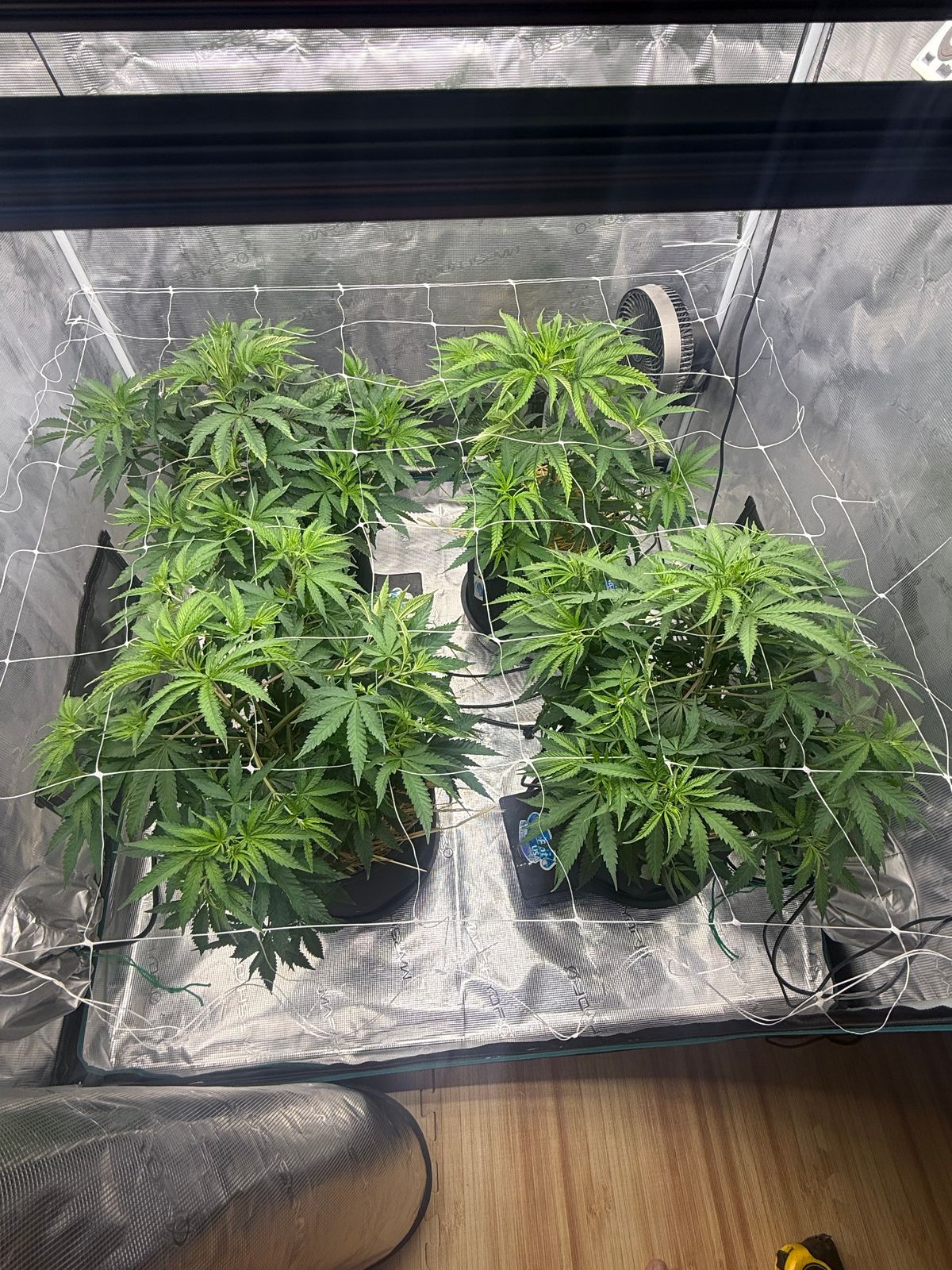

Reviewed by Robert A. S.
Verified Buyer
I recommend this product
They all integrate well together
All these products create tremendous results
Loading...
Was this helpful?
BONUS: 4 Points Per Dollar Through Oct. 31st!!!!


BuildABloom - Amino Chelated Bloom Booster - 1 lb Bag is backordered and will ship as soon as it is back in stock.
BuildASoil is committed to sourcing the highest quality ingredients you can trust. over 10,000 Five Star Reviews and over a decade in business
Shipping is expensive, and it gets more expensive almost every year. We are not going to pretend otherwise. What we can tell you is that we work hard to find the most reliable and affordable way to get your order to you, and we pass along free shipping wherever it makes sense.
Free shipping on any order with two or more items. The one exception is bulk items, meaning the large or heavy products that have to move by freight or oversized parcel. If your cart qualifies, free shipping is applied automatically at checkout.
Most stores set free shipping at a dollar threshold. That works when you sell light things like clothing. We don't. We ship soil, amendments, and heavy real goods that are expensive and awkward to move, so a dollar minimum doesn't reflect what shipping actually costs us.
We are a small business with no outside financial backing, and we are not Amazon. We manufacture, pack, and ship everything in house so we can control quality, which means real people picking, boxing, taping, and labeling every order, and that means real jobs. When we ship a single item for free, the only way to cover it is to raise prices across the board, and we would rather not do that. Asking for two or more items on free orders lets us keep prices lower for everyone and keep shipping sustainable. We hate high shipping costs as much as you do, and this is the fairest way we have found to keep them down.
Every product page shows an estimated delivery window based on current fulfillment and carrier schedules, so you know what to expect before you buy.
Free on eligible orders with two or more items. We select the carrier and method.
Standard ground service.
Same standard transit, but we push it out the door the same day when we can.
Prioritized fulfillment with faster transit.
The fastest option we offer.
Bring your order confirmation and a valid ID.
For large or heavy orders.
For large or heavy orders, faster transit.
We ship with FedEx, UPS, and USPS, and we pick the carrier that gets your order to you reliably at the best cost. We cannot guarantee a specific carrier unless you arrange it with us ahead of time.
Orders to PO Boxes often cost more and usually do not qualify for free shipping. Use a physical address to avoid delays and added fees.
We ship to Alaska, Hawaii, Puerto Rico, Guam, the Northern Mariana Islands, and the US Virgin Islands. Free shipping generally does not apply to large or bulky items going to these destinations, though Hawaii and Alaska have more flexibility depending on carrier policy. Rates are quoted at checkout or on request.
We ship select items to Canada. Canadian customers need to choose "UPS Standard Shipping to Canada" at checkout so your order clears customs cleanly and you avoid surprise brokerage fees. Orders placed with other methods can be delayed or rejected at the border.
Some products ship directly from our vendor partners and show their own estimated ship dates on the product page. Questions about these go to support@buildasoil.com.
Freight orders arrive on pallets by box truck or semi. We assume you need liftgate service unless you tell us otherwise.
Inspect every freight shipment before you sign. Count the packages and check for damage. Signing the delivery receipt confirms the order arrived complete and undamaged, so note any problem on the receipt before you sign it.
Full truckload (FTL) orders are custom quoted after checkout based on your location, order volume, and how the truck will be unloaded.
We email tracking as soon as your order ships. If it does not arrive, check buildasoil.aftership.com with your order details, or email support@buildasoil.com.
This optional add-on at checkout covers your shipment against loss, theft, and damage, and we fast-track those claims for replacement or resolution. Even with protection, photos and documentation help us move carrier claims along faster.
Send all claims to support@buildasoil.com. We do not process claims by phone.
Include:
Hold onto the packaging and any damaged items until the claim is resolved, since carriers may require an inspection.
We help with every carrier claim we can. But once an order is in the carrier's hands, we cannot control delays, damage, or misdelivery, and the carrier makes the final call on claims.

BuildABloom - Amino Chelated Bloom Booster - 1 lb Bag is backordered and will ship as soon as it is back in stock.
Amino chelated bloom booster
Flowering is the most nutrient-hungry thing a plant does. Demand for phosphorus, calcium, and potassium climbs fast, and if that demand outruns the rate your soil can release them, the plant does not get a second chance at that window. BuildABloom closes the gap when you are pushing harder than biology alone can keep up with.
It is a dry, water-in amendment for the flowering half of the season. Micronized minerals bound to OMRI Listed vegan soy amino acids, guaranteed 2-10-5 with 10% calcium, so the phosphate, potassium, and calcium move into the plant instead of locking up in the soil. No bone meal, no guano, no phosphoric acid. It is not a stronger fertilizer than the alternatives. It is a more available one, which is why the rate is so small.
What it is for
Through veg a plant mostly wants nitrogen, and living soil holds plenty. Then it flips and the demand curve changes shape. Now it wants phosphorus to build flower sites, calcium to give that new tissue structure, and potassium to move sugars into it. All at once, for two or three months.
Living soil holds all of it. The question is how fast it can hand it over. Nutrients in a living soil are released by biology, at biology's pace. That works beautifully when the plant's demand and the soil's release rate are in the same neighborhood. Push demand past that pace and you can be sitting on a pot full of phosphorus the plant cannot reach quickly enough.
Three things push demand past it:
If you are running large containers under moderate light with steady watering, you may not need this at all, and we would rather tell you that than sell you a bag. If you are pushing any of those three, this closes the gap, and it is worth catching early: when supply falls behind during bloom you rarely get a clean deficiency you can diagnose, just sites that never fully pack out.
Worth knowing: there is a second way to attack a rate problem, which is to speed the soil up rather than add availability to it. That is what Rootwise Bio-Phos does, using phosphorus-solubilizing biology to free up what your soil already holds. It runs on the same weeks in our schedule. Not required, and not a substitute.
Anything that flowers or fruits. Cannabis growers are most of our customers and the schedule below is written for them, but it works the same on tomatoes, peppers, squash, roses, berries, and fruit trees. Living soil, soilless mixes, containers, beds, or the field. Rates for each are further down.
Why it works
Phosphorus is the most stubborn nutrient in the garden. Put raw rock phosphate in soil and most of it sits there, tied up by calcium and iron, waiting on biology to release it over months or years. That is why so many bloom products reach for phosphoric acid, which is available immediately but is not an approved organic source of phosphorus.
Amino acid chelation is the third option. Hydrolyzed soy protein wraps the mineral in an organic molecule the root already knows how to take in. The mineral gets a ride instead of a fight. That is why a rate this small does this much, and it is why growers report the response showing up in days rather than weeks.
The minerals are also micronized, ground far finer than a standard dry amendment, which puts more surface area in contact with water and root. Fine grind plus amino chelation plus fulvic acid is the entire mechanism, and none of it requires a confined animal byproduct or an acid treatment.
Worth being precise here, because growers ask. Every phosphorus source on earth ends up as the same orthophosphate ion at the root surface, so a claim of no phosphoric acid cannot mean no phosphate. It means no acidulation. We do not treat rock with sulfuric or phosphoric acid to force solubility, and we do not add phosphoric acid as an input. Worth separating two uses here. You will find phosphoric acid in some organic-approved liquids, where it is doing one job: holding pH down so the product does not spoil on the shelf. That is a preservative, not a fertilizer. As an actual source of phosphorus it is not an organic input, and that is the use we are talking about. Availability here comes from fine grinding and amino chelation, not from acid, and that holds all the way back through our suppliers.
The long version of why we avoid bone meal and guano: read our free report on ingredients growers avoid.
Timing
The primary window is the week before you flip, or the week flowering starts. That is the whole instruction. The most common mistake with any bloom product is waiting until week four or five of flower, when the plant has already set its structure and decided how many sites it is building. Feeding it then is feeding a decision that has already been made.
We cannot tell you which calendar week that is. Veg length is your call, and flower runs eight to twelve weeks depending on the variety. Anchor to the flip and ignore the week numbers.
Optional early use: seedlings and clones. At half the normal rate, roughly 1/2 teaspoon per gallon, BuildABloom supports root development on young plants and fresh cuttings. Phosphorus and calcium are what roots are built out of. This is not in the default schedule below and it is not required, but it is a good use for the bag.
Bar height is the weekly watered-in amount from the BuildASoil Way calculator at four plants in 15 gallon containers. Veg is drawn at three weeks so the chart fits. Run yours as long as you like and slide everything after the flip along with it.
Where the potassium comes from at the finish. BuildABloom carries the phosphorus and calcium load through bloom, along with some potassium. As it tapers off through full bloom, coconut water powder ramps up and takes over potassium duty, climbing to roughly 15 grams per gallon in full bloom and 20 in ripening. That final week BuildABloom is out entirely and coconut water powder is the only thing going in.
We ran that coconut water powder through Spectrum Analytic too. It came back at 3.56% soluble potash, with nitrogen and phosphate both under 0.01%. It is potassium and effectively nothing else, which is the whole point of finishing on it. Nitrogen and phosphorus demand fall off hard at the end of a run. Potassium demand does not.
Run the BuildASoil Way calculator for your own garden and it will size every week for your container count, container size, and veg length, then build the shopping list.
Rates
Feeding the full program? Use less. The rates above are for BuildABloom on its own. Inside the BuildASoil Way, where you are also topdressing Craft Blend and BuildAFlower, the calculator runs it lighter because the soil is already carrying phosphorus. Both are correct.
Conversions: 1 tsp = 4 grams · 1 Tbsp = 12 grams · 1 cup = 7 ounces. Solution pH lands around 6.2.
It is a suspension, not a true solution. Plan for that.
Getting organic phosphate this available means grinding it extremely fine, and extremely fine minerals stay in suspension rather than dissolving. Stir it, and keep stirring it while you water. If it sits in a bucket it will settle out and the last plant gets a different feed than the first.
Not suitable for Blumats. Water this in directly. Some growers do run it through drip tape, and the particle size is fine enough, but organics through drip is a project and you should go in expecting to flush lines.
Ingredients
| Input | What it brings |
|---|---|
| Rock phosphate | Phosphate and calcium, micronized and amino chelated |
| Gypsum | Calcium and sulfur without moving soil pH |
| Potassium sulfate | Potash and sulfur, no chloride |
| Magnesium sulfate heptahydrate | Magnesium, the center atom of every chlorophyll molecule |
| Soy protein hydrolysate | The amino acids that do the chelating. OMRI Listed, vegan, non-GMO |
| Fulvic acid | A high-percentage dry fulvic powder, included as a carrier and uptake aid |
Fulvic acid does not appear in the Derived From statement because it is not a guaranteed plant nutrient, and state label rules treat it inconsistently across the country. It is in there regardless, in every batch, doing the job it is in there to do.
The soy amino acid input that does the chelating is OMRI Listed for organic use. The amino chelated materials built from it are registered as Organic Input Materials with the California Department of Food and Agriculture, registered with the Washington State Department of Agriculture for use in organic agriculture, and compliant with the USDA National Organic Program. Raw materials are Class A organic origin, with heavy metal content below the authorized limits for that classification.
The finished blend itself carries no organic listing, because we have not paid for one. Every input is eligible. We just have not written the check. If you run a certified operation and need paperwork, talk to us before you buy and we will send what we have so you can check it against your certifier’s requirements.
Third-party testing
Both analyses below were run by Spectrum Analytic, an independent agricultural lab, using AOAC reference methods. We publish them in full rather than summarizing them.
| Analysis | We guarantee | Aug 2024 | Oct 2022 |
|---|---|---|---|
| Total nitrogen | 2% | 2.37% | 3.31% |
| Available phosphate (P2O5) | 10% | 14.18% | 11.13% |
| Soluble potash (K2O) | 5% | 5.12% | 5.60% |
| Calcium | 10% | not run | 16.84% |
| Magnesium | 1% | not run | 1.55% |
| Zinc | not guaranteed | not run | 0.02% |
The bag is registered as 2-10-5 with 10% calcium. Both tests beat every guaranteed number, on all five nutrients. We label low on purpose, because mined and biological inputs move batch to batch and we would rather the number on the bag be one we can always hit than one that flatters us. Note the calcium: 16.84% against a 10% guarantee, and higher than the phosphate. That is unusual for a bloom product and it is a large part of why this performs.
Fertilizers with a phosphate guarantee are regulated for heavy metals under AAPFCO SUIP #25, the standard most states adopt to decide whether a fertilizer is adulterated. Limits scale with guaranteed phosphate, so ours are calculated against our 10% P2O5 guarantee.
| Metal | Result | Limit | Of limit | |
|---|---|---|---|---|
| Arsenic | 0.41 | 130 | 0.3% | |
| Cadmium | 0.27 | 100 | 0.3% | |
| Cobalt | 0.35 | 1,360 | 0.03% | |
| Lead | 8.2 | 610 | 1.3% | |
| Mercury | <0.2 | 10 | <2% | |
| Molybdenum | 1.36 | 420 | 0.3% | |
| Nickel | 2.5 | 2,500 | 0.1% | |
| Selenium | 0.18 | 260 | 0.07% | |
| Zinc | 200 | 4,200 | 4.8% |
All values in mg/kg. Zinc is a plant nutrient here, not a contaminant, and it shows up in the analysis at 0.02%. Lead is the highest true contaminant at roughly 1% of the allowable level.
Nutrient analysis, August 2024 (PDF)
Full nutrient and heavy metal analysis, October 2022 (PDF)
The other half
BuildAVeg is the same amino chelation approach built for vegetative growth, weighted toward nitrogen instead of phosphorus. Run them as a pair and the handoff happens on its own: BuildAVeg tapers through pre-bloom while BuildABloom ramps up. Neither one is trying to do the other's job.
Tell the calculator how many containers you have, how big they are, and how long you veg. It builds the full week-by-week chart, the topdressing schedule, and the shopping list with real prices and leftover estimates.
Open the BuildASoil Way calculator
Shop BuildAVeg · Shop BIG 6 Micronutrients · Shop Craft Blend
Details
2 to 5 pounds per acre, 3 to 5 applications per season, timed to the crop's reproductive stages rather than the calendar. Do not exceed 15 pounds per acre in a single application.
If you are running a heavier program, space applications 10 to 15 days apart rather than increasing any single dose.
For row crop and larger commercial use, get in touch before you order. Rate, timing, and delivery method all change depending on crop and irrigation setup, and a phone call will save you more than a product page will.
Standalone, living soil rate. A pound is 454 grams, and a teaspoon is 4 grams, so a 1 lb bag is about 113 teaspoons. At 1 teaspoon per gallon that is 113.5 gallons of ready-to-use solution.
Inside the BuildASoil Way program. A four plant garden in 15 gallon containers uses about 15 grams of BuildABloom across an entire 14 week run. A one pound bag has roughly thirty more runs in it after that.
This is the least expensive product in the program by a wide margin, and it is doing a disproportionate amount of the work.
We used to sell it in 50 pound bags. Carriers charge an overweight surcharge above a threshold that a 50 pound bag plus packaging clears, and that fee was landing on customers for no reason other than a round number on the label. We dropped to 44 pounds years ago and the surcharge went away. Same product, better math.
Mixing. Add to water and agitate, and keep agitating while you feed. It is a fine suspension and it will settle.
Storage. Keep it sealed and dry. The soluble salts in it will cake if they take on moisture. It does not expire, but a wet bag turns into a brick.
Compost tea. Add it to the finished tea when you go to apply, not into the brewer. Feeding a bloom booster to a brewing tea feeds the microbes, not the plant.
Rock Phosphate, Gypsum, Soy Protein Hydrolysate, Magnesium Sulfate Heptahydrate, and Potassium Sulfate.
Also contains non plant food ingredient: fulvic acid.
Blended, bagged, and shipped from our facility in Montrose. Every batch goes out the same door the videos get filmed in front of. If something is wrong with a bag, the person who can fix it is a phone call away and works here.
Questions?
We are here to help and our entire staff knows how to grow. Just reach out via chat, email or even phone. We are passionate about growing and want you to succeed.
Payment methods
Your payment information is processed securely. We do not store credit card details nor have access to your credit card information.
All these products create tremendous results
Perfect water in amendment for early to mid bloom
Must have in flower
Great product just when you don't thank it's making a difference after about three days I could see my plants reacting to the product.a little bit more aroma and swelling good .that is the differenc1e I see with the bloom.


Amino chelated bloom booster
Flowering is the most nutrient-hungry thing a plant does. Demand for phosphorus, calcium, and potassium climbs fast, and if that demand outruns the rate your soil can release them, the plant does not get a second chance at that window. BuildABloom closes the gap when you are pushing harder than biology alone can keep up with.
It is a dry, water-in amendment for the flowering half of the season. Micronized minerals bound to OMRI Listed vegan soy amino acids, guaranteed 2-10-5 with 10% calcium, so the phosphate, potassium, and calcium move into the plant instead of locking up in the soil. No bone meal, no guano, no phosphoric acid. It is not a stronger fertilizer than the alternatives. It is a more available one, which is why the rate is so small.
What it is for
Through veg a plant mostly wants nitrogen, and living soil holds plenty. Then it flips and the demand curve changes shape. Now it wants phosphorus to build flower sites, calcium to give that new tissue structure, and potassium to move sugars into it. All at once, for two or three months.
Living soil holds all of it. The question is how fast it can hand it over. Nutrients in a living soil are released by biology, at biology's pace. That works beautifully when the plant's demand and the soil's release rate are in the same neighborhood. Push demand past that pace and you can be sitting on a pot full of phosphorus the plant cannot reach quickly enough.
Three things push demand past it:
If you are running large containers under moderate light with steady watering, you may not need this at all, and we would rather tell you that than sell you a bag. If you are pushing any of those three, this closes the gap, and it is worth catching early: when supply falls behind during bloom you rarely get a clean deficiency you can diagnose, just sites that never fully pack out.
Worth knowing: there is a second way to attack a rate problem, which is to speed the soil up rather than add availability to it. That is what Rootwise Bio-Phos does, using phosphorus-solubilizing biology to free up what your soil already holds. It runs on the same weeks in our schedule. Not required, and not a substitute.
Anything that flowers or fruits. Cannabis growers are most of our customers and the schedule below is written for them, but it works the same on tomatoes, peppers, squash, roses, berries, and fruit trees. Living soil, soilless mixes, containers, beds, or the field. Rates for each are further down.
Why it works
Phosphorus is the most stubborn nutrient in the garden. Put raw rock phosphate in soil and most of it sits there, tied up by calcium and iron, waiting on biology to release it over months or years. That is why so many bloom products reach for phosphoric acid, which is available immediately but is not an approved organic source of phosphorus.
Amino acid chelation is the third option. Hydrolyzed soy protein wraps the mineral in an organic molecule the root already knows how to take in. The mineral gets a ride instead of a fight. That is why a rate this small does this much, and it is why growers report the response showing up in days rather than weeks.
The minerals are also micronized, ground far finer than a standard dry amendment, which puts more surface area in contact with water and root. Fine grind plus amino chelation plus fulvic acid is the entire mechanism, and none of it requires a confined animal byproduct or an acid treatment.
Worth being precise here, because growers ask. Every phosphorus source on earth ends up as the same orthophosphate ion at the root surface, so a claim of no phosphoric acid cannot mean no phosphate. It means no acidulation. We do not treat rock with sulfuric or phosphoric acid to force solubility, and we do not add phosphoric acid as an input. Worth separating two uses here. You will find phosphoric acid in some organic-approved liquids, where it is doing one job: holding pH down so the product does not spoil on the shelf. That is a preservative, not a fertilizer. As an actual source of phosphorus it is not an organic input, and that is the use we are talking about. Availability here comes from fine grinding and amino chelation, not from acid, and that holds all the way back through our suppliers.
The long version of why we avoid bone meal and guano: read our free report on ingredients growers avoid.
Timing
The primary window is the week before you flip, or the week flowering starts. That is the whole instruction. The most common mistake with any bloom product is waiting until week four or five of flower, when the plant has already set its structure and decided how many sites it is building. Feeding it then is feeding a decision that has already been made.
We cannot tell you which calendar week that is. Veg length is your call, and flower runs eight to twelve weeks depending on the variety. Anchor to the flip and ignore the week numbers.
Optional early use: seedlings and clones. At half the normal rate, roughly 1/2 teaspoon per gallon, BuildABloom supports root development on young plants and fresh cuttings. Phosphorus and calcium are what roots are built out of. This is not in the default schedule below and it is not required, but it is a good use for the bag.
Bar height is the weekly watered-in amount from the BuildASoil Way calculator at four plants in 15 gallon containers. Veg is drawn at three weeks so the chart fits. Run yours as long as you like and slide everything after the flip along with it.
Where the potassium comes from at the finish. BuildABloom carries the phosphorus and calcium load through bloom, along with some potassium. As it tapers off through full bloom, coconut water powder ramps up and takes over potassium duty, climbing to roughly 15 grams per gallon in full bloom and 20 in ripening. That final week BuildABloom is out entirely and coconut water powder is the only thing going in.
We ran that coconut water powder through Spectrum Analytic too. It came back at 3.56% soluble potash, with nitrogen and phosphate both under 0.01%. It is potassium and effectively nothing else, which is the whole point of finishing on it. Nitrogen and phosphorus demand fall off hard at the end of a run. Potassium demand does not.
Run the BuildASoil Way calculator for your own garden and it will size every week for your container count, container size, and veg length, then build the shopping list.
Rates
Feeding the full program? Use less. The rates above are for BuildABloom on its own. Inside the BuildASoil Way, where you are also topdressing Craft Blend and BuildAFlower, the calculator runs it lighter because the soil is already carrying phosphorus. Both are correct.
Conversions: 1 tsp = 4 grams · 1 Tbsp = 12 grams · 1 cup = 7 ounces. Solution pH lands around 6.2.
It is a suspension, not a true solution. Plan for that.
Getting organic phosphate this available means grinding it extremely fine, and extremely fine minerals stay in suspension rather than dissolving. Stir it, and keep stirring it while you water. If it sits in a bucket it will settle out and the last plant gets a different feed than the first.
Not suitable for Blumats. Water this in directly. Some growers do run it through drip tape, and the particle size is fine enough, but organics through drip is a project and you should go in expecting to flush lines.
Ingredients
| Input | What it brings |
|---|---|
| Rock phosphate | Phosphate and calcium, micronized and amino chelated |
| Gypsum | Calcium and sulfur without moving soil pH |
| Potassium sulfate | Potash and sulfur, no chloride |
| Magnesium sulfate heptahydrate | Magnesium, the center atom of every chlorophyll molecule |
| Soy protein hydrolysate | The amino acids that do the chelating. OMRI Listed, vegan, non-GMO |
| Fulvic acid | A high-percentage dry fulvic powder, included as a carrier and uptake aid |
Fulvic acid does not appear in the Derived From statement because it is not a guaranteed plant nutrient, and state label rules treat it inconsistently across the country. It is in there regardless, in every batch, doing the job it is in there to do.
The soy amino acid input that does the chelating is OMRI Listed for organic use. The amino chelated materials built from it are registered as Organic Input Materials with the California Department of Food and Agriculture, registered with the Washington State Department of Agriculture for use in organic agriculture, and compliant with the USDA National Organic Program. Raw materials are Class A organic origin, with heavy metal content below the authorized limits for that classification.
The finished blend itself carries no organic listing, because we have not paid for one. Every input is eligible. We just have not written the check. If you run a certified operation and need paperwork, talk to us before you buy and we will send what we have so you can check it against your certifier’s requirements.
Third-party testing
Both analyses below were run by Spectrum Analytic, an independent agricultural lab, using AOAC reference methods. We publish them in full rather than summarizing them.
| Analysis | We guarantee | Aug 2024 | Oct 2022 |
|---|---|---|---|
| Total nitrogen | 2% | 2.37% | 3.31% |
| Available phosphate (P2O5) | 10% | 14.18% | 11.13% |
| Soluble potash (K2O) | 5% | 5.12% | 5.60% |
| Calcium | 10% | not run | 16.84% |
| Magnesium | 1% | not run | 1.55% |
| Zinc | not guaranteed | not run | 0.02% |
The bag is registered as 2-10-5 with 10% calcium. Both tests beat every guaranteed number, on all five nutrients. We label low on purpose, because mined and biological inputs move batch to batch and we would rather the number on the bag be one we can always hit than one that flatters us. Note the calcium: 16.84% against a 10% guarantee, and higher than the phosphate. That is unusual for a bloom product and it is a large part of why this performs.
Fertilizers with a phosphate guarantee are regulated for heavy metals under AAPFCO SUIP #25, the standard most states adopt to decide whether a fertilizer is adulterated. Limits scale with guaranteed phosphate, so ours are calculated against our 10% P2O5 guarantee.
| Metal | Result | Limit | Of limit | |
|---|---|---|---|---|
| Arsenic | 0.41 | 130 | 0.3% | |
| Cadmium | 0.27 | 100 | 0.3% | |
| Cobalt | 0.35 | 1,360 | 0.03% | |
| Lead | 8.2 | 610 | 1.3% | |
| Mercury | <0.2 | 10 | <2% | |
| Molybdenum | 1.36 | 420 | 0.3% | |
| Nickel | 2.5 | 2,500 | 0.1% | |
| Selenium | 0.18 | 260 | 0.07% | |
| Zinc | 200 | 4,200 | 4.8% |
All values in mg/kg. Zinc is a plant nutrient here, not a contaminant, and it shows up in the analysis at 0.02%. Lead is the highest true contaminant at roughly 1% of the allowable level.
Nutrient analysis, August 2024 (PDF)
Full nutrient and heavy metal analysis, October 2022 (PDF)
The other half
BuildAVeg is the same amino chelation approach built for vegetative growth, weighted toward nitrogen instead of phosphorus. Run them as a pair and the handoff happens on its own: BuildAVeg tapers through pre-bloom while BuildABloom ramps up. Neither one is trying to do the other's job.
Tell the calculator how many containers you have, how big they are, and how long you veg. It builds the full week-by-week chart, the topdressing schedule, and the shopping list with real prices and leftover estimates.
Open the BuildASoil Way calculator
Shop BuildAVeg · Shop BIG 6 Micronutrients · Shop Craft Blend
Details
2 to 5 pounds per acre, 3 to 5 applications per season, timed to the crop's reproductive stages rather than the calendar. Do not exceed 15 pounds per acre in a single application.
If you are running a heavier program, space applications 10 to 15 days apart rather than increasing any single dose.
For row crop and larger commercial use, get in touch before you order. Rate, timing, and delivery method all change depending on crop and irrigation setup, and a phone call will save you more than a product page will.
Standalone, living soil rate. A pound is 454 grams, and a teaspoon is 4 grams, so a 1 lb bag is about 113 teaspoons. At 1 teaspoon per gallon that is 113.5 gallons of ready-to-use solution.
Inside the BuildASoil Way program. A four plant garden in 15 gallon containers uses about 15 grams of BuildABloom across an entire 14 week run. A one pound bag has roughly thirty more runs in it after that.
This is the least expensive product in the program by a wide margin, and it is doing a disproportionate amount of the work.
We used to sell it in 50 pound bags. Carriers charge an overweight surcharge above a threshold that a 50 pound bag plus packaging clears, and that fee was landing on customers for no reason other than a round number on the label. We dropped to 44 pounds years ago and the surcharge went away. Same product, better math.
Mixing. Add to water and agitate, and keep agitating while you feed. It is a fine suspension and it will settle.
Storage. Keep it sealed and dry. The soluble salts in it will cake if they take on moisture. It does not expire, but a wet bag turns into a brick.
Compost tea. Add it to the finished tea when you go to apply, not into the brewer. Feeding a bloom booster to a brewing tea feeds the microbes, not the plant.
Rock Phosphate, Gypsum, Soy Protein Hydrolysate, Magnesium Sulfate Heptahydrate, and Potassium Sulfate.
Also contains non plant food ingredient: fulvic acid.
Blended, bagged, and shipped from our facility in Montrose. Every batch goes out the same door the videos get filmed in front of. If something is wrong with a bag, the person who can fix it is a phone call away and works here.
Size