Table of Contents
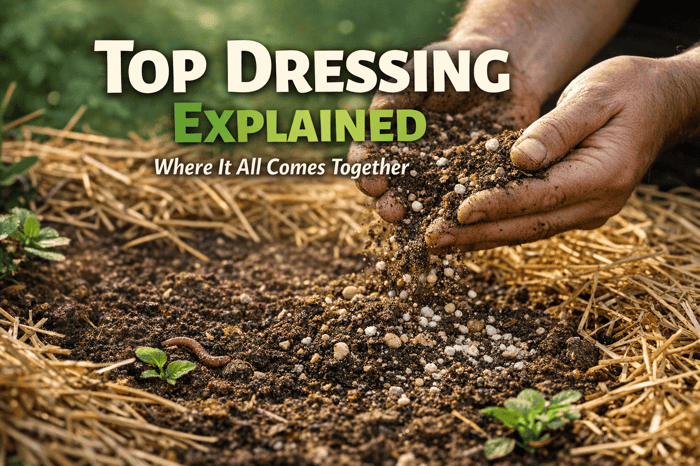
There’s something about top dressing living soil that took me a long time to really understand, not because it’s complicated, but almost because it’s too simple. It’s one of those things that’s sitting right in front of you the whole time, but until it clicks, you keep looking for something more advanced or more precise.
What finally made it click
What finally made it click for me wasn’t learning a new technique, it was noticing a pattern. I was reading all these different books and studying different growing styles, and at first they all felt like completely different systems. One person is doing mulch, another is doing natural farming, another is focused on minerals, and someone else is building layered soils with specific inputs. It felt like I had to pick one path and commit to it.
But the longer I stayed with it, the more I started to realize that they weren’t actually different at the core. They were all describing the same process, just from different perspectives and at different speeds.
Many methods - Same Fundamental Truth
When you look at Ruth Stout, she is laying down thick mulch, hay and straw, just piling it on season after season and letting it break down naturally. She’s not chasing nutrients or trying to feed the plant directly, she’s feeding the surface of the soil and trusting that process. Her intent is to have a garden that feeds the family with as little work as possible.
Then you read Fukuoka, and it’s important to really understand what he was doing in The One-Straw Revolution. He was literally spreading straw back onto the land, returning organic matter to the surface and letting nature cycle it. No inputs, no disturbance, just continuous coverage and decomposition happening right where it falls. He also went against the standard rice growing methods of flooding the field. Again, as little work as possible.... Fukuoka called it "do nothing farming."
On acreage, with seasons, crop rotations, and time on your side, that approach can work beautifully. You can lean fully into nature and let those slower cycles build year after year, very similar to what both Ruth Stout and Fukuoka were demonstrating.
But then you move into a different context.
We are still discussing top dressing living soil... but now you’re growing fast annual plants. You’re working in pots, beds, indoor environments. You’ve got a limited window and you’re trying to get everything done in a single season. In that situation, you start to see why people like Steve Solomon began working with finer ground inputs, mineral balancing, and complete organic fertilizers. It’s not that the philosophy changed, it’s that the timeline and crops did.
By grinding materials finer and using more available forms of organic inputs, you’re allowing the biology to process nutrients faster so they can actually contribute to that same season’s growth.
Then you get into The Rev, who takes that same idea but expresses it differently. Instead of relying on a single complete mix, he’s layering inputs, using spikes, and separating things into veg and bloom style feeding. It’s still organic, still soil-based, but he’s guiding the process more actively within that shorter window.
So while all of these approaches are rooted in the same idea, they’re adapted to different goals. On land, over time, you can let things move slowly and naturally. In containers with fast-growing annuals, you help the system move faster so it can keep up.
That was a big piece for me, realizing it’s not about choosing the “right” method, it’s about understanding what’s actually happening and then using the version of it that fits your situation.
Using all of these methods
At BuildASoil, that’s really where we landed. We believe in those natural systems, we believe in mulch, we believe in biology doing the work, but we also recognize that most of us are not working with perfect native soil that has been building for decades. We’re in pots, raised beds, indoor environments, and in those situations, you can’t always wait years for everything to cycle perfectly on its own.
So instead of replacing the system, we support it. We bring in compost, worm castings, minerals, seed meals, things that are already part of that natural process, and we apply them the same way nature would, which is right on the surface.
There’s another piece to this that I think gets missed a lot, and it’s probably the reason some people try top dressing and don’t get the results they expect. Top dressing living soil only works when that top layer is actually alive. If the surface of your soil is dry, if there’s no mulch, no organic matter, no biological activity, and you throw a handful of amendments on top, nothing really happens. There’s nothing there to process it, nothing to break it down, and the plant isn’t even focused in that zone. Some people have tried this and think... this topdressing stuff doesn't work, or, it's too slow... When really, it was the technique.
What you want instead is to build that layer from the beginning so it stays active the entire time. Compost or worm castings on the surface, a consistent mulch layer, moisture staying in that top zone, and regular light inputs instead of waiting too long. If you look at any healthy natural system, whether it’s a forest or a field, the surface is never bare. It’s always covered, always cycling, always full of life.
And when you maintain that kind of environment, something else starts to happen. The plant adapts to it. It starts to push feeder roots right into that top layer because that’s where the nutrients are being processed and made available. So by the time you come back and top dress again, the plant is already there, the biology is already there, and everything is in place to receive that next layer of inputs. This is when growers start to realize, this stuff actually works!!
That’s when top dressing living soil really starts to feel powerful, because you’re not introducing something new into the system, you’re continuing a process that’s already active.
This also ties into how the root zone actually works. Plants will send roots deeper for minerals and stability, but a large portion of the most active roots are near the surface, especially in a well-built living soil system. That’s where organic matter is breaking down, where microbes are concentrated, and where nutrients are constantly cycling. So instead of trying to feed deep into the soil, you’re building and maintaining that top layer and letting everything move naturally from there.
Timing starts to make more sense when you look at it this way too. Top dressing isn’t immediate, it usually takes about one to two weeks before it really starts to kick in, so you’re not reacting to a deficiency in the moment, you’re thinking ahead and setting the plant up before it reaches that point.
A simple rhythm that works well for most people looks like:
- Before flipping to flower
- Around week 3 or 4 of flower if growing a longer flowering variety
- Or anytime the plant starts slowing down
For vegetables, it usually lines up as:
- A couple weeks before planting
- Then again mid season for heavier feeders
Another thing that tends to come up is how much to use, and this is where people often overdo topdressing living soil. It’s easy to assume that more inputs will lead to better results, but with top dressing it’s more about consistency than quantity. A light, even layer applied at the right time will almost always outperform heavy applications that overwhelm the system. Top dressing living soil is simple when you follow the basic guidelines.
As a general guide for top dressing living soil:
- About ¼ cup per plant plus compost
- Around 15 pounds per 100 square feet
- 2 to 4 cups per cubic foot when mixing soil
Start light, observe, and adjust as you go. You can always add more later, but if you overdo it, you can't just take it back out.
As far as what to actually use, it doesn’t have to be complicated. For top dressing living soil you can get really far with something as simple as compost and worm castings. If you want to build something more complete, you can start layering in seed meals, mineral inputs like basalt or rock dust, and something like kelp for micronutrients.
A simple complete organic fertilizer style approach could look like:
- Compost or worm castings as your base
- A mix of seed meals like neem, karanja, mustard seed, camelina meal, organic non gmo soy,
- Mineral inputs like basalt or glacial rock dust
- A phosphorus input like Fish Bone Meal or Bran.
- A small amount of kelp meal
That’s essentially what something like Craft Blend is doing, combining those ideas into one mix so you don’t have to overthink it.
When you step back and look at all of this together, it simplifies things in a way that’s hard to unsee. No matter which method you follow, whether it’s natural farming, no work gardening, mineral balancing, or a modern living soil approach, they all come back to the same core idea.
You are adding to the surface, and you are letting the soil process it. These methods work when you have a busy life and will produce quality and quantity without taking over your life.
Top dressing living soil isn’t just another technique, it’s the mechanism that makes living soil work. That top layer, the mulch, the organic matter, that’s essentially the stomach of the soil. That’s where everything gets broken down, transformed, and made available to the plant.
Once you start thinking about it that way, it becomes a lot easier to stay consistent and a lot easier to trust the process. You’re not trying to force growth, you’re supporting a system that already knows how to do it.
Check out the complete system if you want to see more than just top dressing living soil:
https://buildasoil.com/pages/the-complete-system
BuildAFlower Top Dress Kit

$33.00
BuildAFlower Top Dress Kit Turn healthy plants into heavy, aromatic flowers. BuildAFlower is a complete, biologically active flowering top dress designed to replace multiple bottled bloom products with one simple soil-powered solution. If flowering is where you care the most… read more
BuildASoil Craft Blend - Nutrient Pack

$31.00
Made in Montrose, Colorado Everything your soil needs.One bag.No feed schedule. Craft Blend feeds a living plant through a top dress, builds a soil from scratch, or re-amends one you already have. Sixteen premium amendments doing the work, so the… read more
FAQs
What is top dressing in living soil?
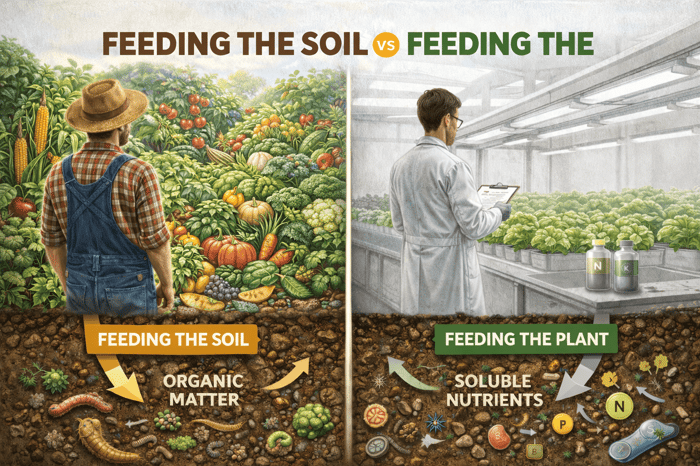
Top dressing is the practice of adding organic matter and nutrients to the surface of the soil and allowing microbes and biology to break it down over time. Instead of feeding the plant directly, you are feeding the soil, and the soil feeds the plant.
How often should you top dress?
Most growers top dress when establishing a new container. Then again before flipping to flower. With plants that are really demanding or longer flowers you may again around week 3 or 4 of flower. For vegetables, it’s common to top dress a couple weeks before planting and again mid-season for heavier feeders.
How long does top dressing take to work?
When feeder roots are established it can be within 24 hours. That being said, top dressing usually takes about 1 to 2 weeks to fully kick in. The nutrients need time to be broken down by soil biology before they become available to the plant.
What can you use for top dressing?
You can use compost, worm castings, seed meals, kelp meal, mineral amendments like rock dust, or a complete organic fertilizer blend. The goal is to provide organic inputs that soil biology can process.
Do you need to mix top dressing into the soil?
To avoid creating hard layers, top dressing works best when scratched into the surface and when added along with compost or castings. Still though, even with light mixing, top dressing is meant to stay on the surface where biology is most active. Water and microbes will naturally move nutrients into the soil over time. Lightly working it into the very top layer is fine, but deep mixing is not necessary.
Can you overdo top dressing?
It's a little harder to do when on top of the soil, but....Yes. Applying too much at once can overwhelm the system and lead to imbalances. It’s better to apply light, consistent layers and observe how your plants respond, you can always add more later.
Why isn’t my top dressing working?
The most common reason is a lack of an active surface layer. If your soil surface is dry, bare, or lacking biology, the amendments won’t break down properly. Keeping a moist mulch layer with compost and organic matter is key for top dressing to work.
Why is the top layer of soil so important?
The top layer is where most biological activity happens. It’s where organic matter breaks down, microbes thrive, and feeder roots develop. Top dressing works best because it feeds this active zone directly.
Do plants really feed from the top of the soil?
Yes. While plants send roots deeper for minerals and support, a large portion of feeder roots stay near the surface where nutrients are actively cycling. Building a rich top layer encourages roots to stay in that zone.
Do you need a soil test to top dress properly?
Not necessarily. Soil testing can help if you are trying to correct specific issues, but many growers succeed by using diverse organic inputs and observing their plants closely.