Table of Contents
Feeding the Soil vs Feeding the Plant: Understanding the Difference
Hello and welcome to another BuildASoil FAQ. Today we're covering one of the most important foundational concepts in living organic soil growing: feeding the soil vs feeding the plant
So, do you know? Are you feeding the plant, or are you feeding the soil?
At first this idea can sound confusing. After all, most growers just want healthy plants. So when someone says “feed the soil, not the plant,” it raises a lot of questions.
What does that actually mean? And why does it matter?
Understanding this difference can completely change how you approach growing.
The Conventional Approach: Feeding the soil vs Feeding the plant
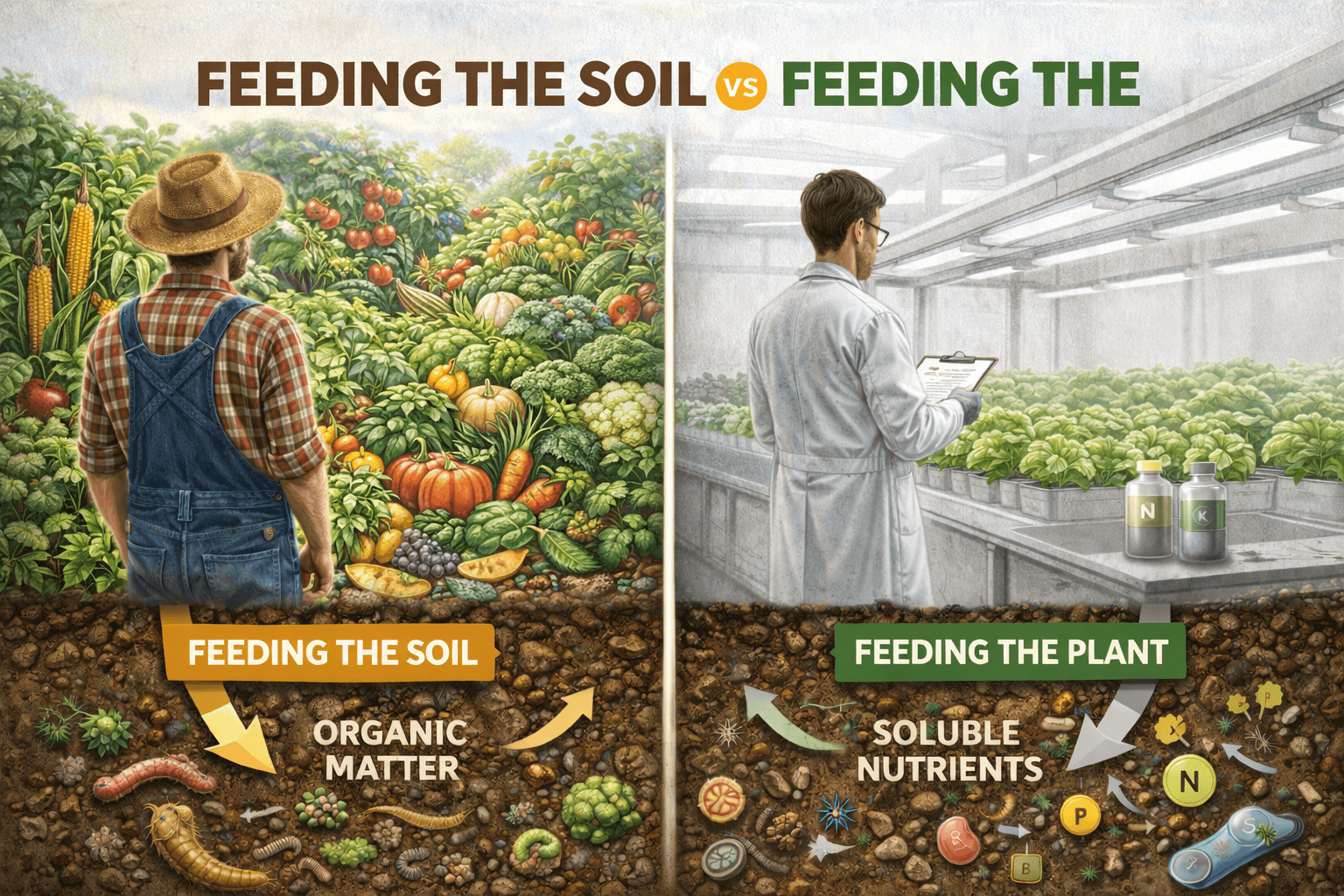
Most modern growing systems are based on what we could call the plant-feeding model.
This approach focuses on delivering nutrients directly to the plant in soluble form. Think hydroponics, salt-based fertilizers, and feeding charts.
In these systems:
- Nutrients are dissolved into water.
- The plant absorbs them directly through the roots.
- The grower controls exactly what the plant receives.
This can work very well. It can grow strong plants and high yields.
But it also puts the grower in charge of constantly managing nutrient inputs, measurements, and corrections.
In a way, the grower becomes the plant’s digestive system.
The Living Soil Approach: Feeding the Soil
Living organic soil operates differently... When a grower first hears, "feeding the soil vs feeding the plant," it can be a little confusing.
Instead of feeding nutrients directly to the plant, we focus on feeding and supporting the soil ecosystem.
This includes:
- Bacteria
- Fungi
- Protozoa
- Nematodes
- Earthworms
- Other beneficial organisms
These organisms break down organic matter and minerals in the soil, turning them into plant-available nutrients.
Rather than force-feeding the plant, we allow the biological system to regulate nutrient availability naturally.
In this model, the plant communicates with soil microbes through root exudates, and the microbes help deliver the nutrients the plant needs.
Availability becomes a biological process, not just a chemical one.
The “Half-In Organic” Trap
This is where many growers get stuck.
Some people begin using organic inputs, but they still approach growing with the same mindset used in hydroponics or synthetic systems.
They might:
- Skip the mulch layer
- Focus heavily on soluble teas
- Try to make every nutrient immediately available
- Constantly run soil tests
- Adjust inputs every week
In other words, they switch ingredients but keep the same control-based mindset.
This is what I call the “half-in organic trap.”
You’re using organic materials, but you’re still trying to micromanage the system like a hydro grow.
These growers usually follow soil testing protocols and think that they are "feeding the soil vs feeding the plant" but soon realize that there is not way to be directly in control and that being a steward requires some trust. Eventually, most growers learn to use soil testing occasionally if at all because the results are so great the trust begins to develop.
A Helpful Analogy: Processed Food vs Real Food
Think about human health.
Imagine someone trying to stay healthy by eating mostly processed foods while constantly visiting the doctor and getting blood tests.
They monitor every biomarker, adjust supplements weekly, and try to manage their health through precision testing.
Now compare that to someone who simply eats real whole foods:
- Clean Proteins like Grass Fed Beef
- Healthy fats
- Real Whole Foods
- No Chemical Additives
- Plenty of water
That person may still get occasional illness, but they aren’t obsessing over numbers every week and their health is typically much better and they don't have a regular doctor. If they get sick, they rest and heal naturally.
Because the foundation of their diet is solid.
The same principle applies to soil.
If you build a strong biological foundation with balanced minerals, compost, organic matter, and a mulch layer, the system naturally stays within healthy ranges.
Soil Testing: A Tool, Not a Crutch
Soil testing can absolutely be useful.
It can help establish mineral balance and identify major issues.
But it’s important to remember something:
A soil test is a snapshot, not a diagnosis.
Soil is dynamic. Different samples taken from the same bed can produce slightly different results.
Testing too frequently can lead growers to chase numbers instead of understanding the biological system.
For large farms or commercial operations, frequent testing may make sense.
But most growers don’t need laboratory-level micromanagement to grow incredible plants.
The same goes for tools like microscopes.
They can be powerful learning tools, but you don’t need to see every microbe to benefit from the soil food web.
The Importance of the Mulch Layer
One of the simplest and most powerful parts of living soil is the mulch layer.
In nature, soil is almost never bare.
The forest floor is covered with leaves, organic matter, and decomposing plant material.
This mulch layer:
- Protects moisture
- Regulates temperature
- Provides food for microbes
- Supports fungal networks
- Drives carbon cycling
Mulch isn’t decorative... although a freshly mulched bed does look really good.
It’s protective cover for the soil ecosystem. Almost like the skin of the soil.
Most growers that follow these systems have benefited from them without knowing exactly why, Think about the world record tomato grower, Charles Wilbur, that uses these same systems and the famous home gardener Ruth Stout and her no work gardening with extra thick mulch layer.
After seeing the benefits and reading many books I stumbled across one that helped connect the dots and I want to share it with you....
The Humusphere: Rethinking Plant Nutrition
Years ago I read a book called The Humusphere by Herwig Pommeresche.
This book explores the deeper biology of soil and humus systems and challenges the conventional idea that plants only absorb nutrients as water-soluble salts.
Pommeresche pointed to research suggesting that plants can absorb much more complex forms of nutrients, including larger molecules and even entire living cells.
This happens through processes like endocytosis, where root cells can engulf particles and bring them into the plant.
Reading that book opened the door to a much deeper understanding of plant nutrition.
Here is an excerpt that I found interesting:
"Recognizing that endocytosis takes place in plants is an important piece of support for the microbiological model of the cycle of living material, which includes microorganisms.
But there is also another area of microbiological research that seems to have completely lost the attention of the modern scientific community. It essentially represents the second half of the endosymbiosis theory developed by Lynn Margulis and the adherents of the Gaia hypothesis. This is remutation, postulated by Hugo Schanderl. In 1947, Schanderl1 had already succeeded in breeding and regenerating remutating, as he called it – living, viable microorganisms out of certain cell components, such as mitochondria and chloroplasts, from plant tissue after it died. These experiments showed that any living cell is capable of releasing new life after it has died.
Schanderl described every mutation in agricultural soil bacteriology as follows in 19702: “When a plant is buried, the soil is enriched with bacteria not only because a vast number of existing soil bacteria decompose and break down the plant corpse, multiplying tremendously in the process, but also because the soil is enriched with bacteria from higher plants as they break themselves down. Certainly, bacteria present in the soil also find abundant nutrients during composting, which allows them to multiply. But, as can be experimentally demonstrated, no bacteria need to enter from the outside whatsoever for decomposition to take place and a breeding ground of bacteria to arise.”
He continues in the same article: “A significant proportion of the bacteria regenerated from plant cell organelles present in cow dung return to the planting soil. Unlike artificial fertilizer, this kind of fertilizer is filled with life and enriches the soil with bacterial life, increasing it’s fertility.”
After more than fifty years of being ignored and denied by the sciences, the remutation model is now being indirectly confirmed by cellular and molecular research. Autonomous DNA that is independent of the cell’s nucleus has been found in both mitochondria and chloroplasts, which has led to acknowledgement of the endosymbiosis theory. In evolutionary terms, this also describes how ancient single-celled microorganisms relinquished their independence in favor of organizing into larger cells and, in a manner of speaking, were relegated into subordinate cell components.
Schanderl’s remutation model implies that all decomposing organic substances, as well as all seeds that are starting the development of new life, are most likely capable of reshaping their own cell components into autonomous microorganisms such that living plants can employ their help – if they reabsorb them from their surroundings – to carry on their metabolic processes. The question also arises as to what extent living cells are even able to absorb an exclusive diet of inorganic, water-soluble salt ions. Page 43-45"
So after reading this book, my view started to change and my mind was opened as to the processes that may be occurring and if so, how to support those natural process's as a good steward for the soil and plants.
It was after reading this book that the impact of the more recent Dr. White's work fully connected and sent me down a new rabbit hole. This stuff is fascinating!! Talk about feeding the soil vs feeding the plant!!!!
Rhizophagy: New Research Connecting the Dots
Later I discovered the work of Dr. James White and his research on the rhizophagy cycle.
Rhizophagy is the term used for "Plant Endocytosis" which was the process discussed in the Humusphere book now given a specific name.
This research shows that microbes can enter plant root cells, where the plant extracts nutrients from them before releasing them back into the soil.
In other words, microbes may act as carriers for nutrients entering the plant.
Even more fascinating, research suggests microbes may live inside plant tissues, including glandular trichomes. If you haven't researched this yet, I highly recommend you go to youtube and watch some of Dr. White's videos, they will blow your mind.
Since trichomes are full of biology, it would seem that means the biology in the soil may be directly connected to the very structures responsible for producing resins and secondary metabolites.
It’s an incredible reminder that the plant and the soil ecosystem are deeply interconnected.
What feeding the soil vs feeding the plant Actually Looks Like
In practice, feeding the soil is surprisingly simple.
It involves focusing on a few foundational principles:
- Balanced mineral soil
- High-quality compost and worm castings
- Consistent moisture
- A mulch layer
- Periodic top-dressing to replenish nutrients
Instead of reacting constantly, we support the ecosystem and let it do the work.
Think of it this way:
We provide the buffet. The plant decides what it needs and will work with the microbes to use what it wants. This is far better than having to be in full control.
Final Thoughts
Both approaches, feeding the soil vs feeding the plant, can grow plants.
But living soil focuses on building a system that becomes more stable and productive over time.
Rather than controlling every nutrient input, we focus on building the biological and mineral foundation that allows plants to thrive.
If your plant outgrows your container you can still feed the plant with organic inputs, but when following proper practices you won't have to.
If you want to control every nutrient molecule, feed the plant.
If you want a system that trusts nature with every cycle, feed the soil.
Build the soil well, and the plant will follow.... This is what it means to be feeding the soil vs feeding the plant. It's like building a bird house, the birds will come, they will likely even fight over the bird house, but you don't need to worry about building the bird... Same with soil, provide proper conditions for feeding the soil vs feeding the plant and it all happens and microbes show up.
This is why we use the mulch layer, why we chop and drop cover crops, why we use worms, why we use dry amendments and compost.... This is why we grow the BuildASoil way!! Feeding the soil vs feeding the plant becomes almost a lifestyle and It works so well and continually teaches about life. I encourage you to jump in and try and reach our to us if you have questions.
Here is a link to Setting up a new container with mulch layer
FAQs
What does feeding the soil vs feeding the plant mean?
Feeding the soil vs feeding the plant refers to two different growing approaches. Feeding the plant focuses on delivering soluble nutrients directly to the roots, while feeding the soil focuses on supporting the soil ecosystem, microbes, fungi, and organic matter, which naturally makes nutrients available to plants over time.
Why do living soil growers feed the soil instead of the plant?
Living soil growers feed the soil because soil microbes help cycle nutrients, improve plant resilience, and create a more stable growing system. When the soil ecosystem is healthy, microbes break down organic matter and minerals and deliver nutrients to plants as they are needed.
Can plants really get nutrients from microbes?
Yes. Research on the rhizophagy cycle suggests that microbes can enter plant root cells where nutrients are extracted before the microbes are released back into the soil. This shows that microbes can play a direct role in delivering nutrients to plants.
Why is a mulch layer important in living soil?
A mulch layer protects the soil surface, helps retain moisture, regulates temperature, and provides food for soil microbes. In nature, soil is rarely bare, and the mulch layer supports the biological activity that drives nutrient cycling.
Do I need constant soil testing to grow healthy plants?
No. Soil testing can be a helpful tool for understanding mineral balance, but it should be used as one source of information. Soil is dynamic and test results can vary depending on sampling. Observing plant health and maintaining a balanced soil ecosystem are just as important.
Do I need a microscope to grow with living soil?
No. Microscopes can be useful learning tools for studying soil biology, but they are not required to grow successfully in living soil. By building a healthy soil ecosystem with compost, organic matter, and mulch, growers can benefit from microbial activity without needing to see every microbe.
Is feeding the soil better than feeding the plant?
In my opinion, YES. This system is much more forgiving and will product more consistent results for growers living a normal busy life. That being said, both approaches can grow plants successfully. Feeding the plant offers precise control over nutrient inputs, while feeding the soil focuses on building a resilient ecosystem that improves over time. Many living soil growers prefer feeding the soil because it supports long-term soil health and stability.
What does “feed the soil, not the plant” mean?
“Feed the soil, not the plant” means focusing on building a healthy soil ecosystem instead of directly supplying nutrients to the plant. In living soil systems, microbes break down organic matter and minerals, making nutrients available to plants naturally through biological processes. Think dry amendments and compost in the mulch layer instead of water soluble nutrient bottles.
How do microbes help plants get nutrients?
Soil microbes break down organic materials and minerals into forms plants can use. Bacteria, fungi, and other organisms recycle nutrients in the soil and interact with plant roots through processes like root exudates and the rhizophagy cycle, helping deliver nutrients to the plant.
What is the rhizophagy cycle?
The rhizophagy cycle is a process discovered by Dr. James White where microbes enter plant root cells. The plant extracts nutrients from the microbes before releasing them back into the soil to gather more nutrients. This cycle helps explain how microbes can directly contribute to plant nutrition. This same process was discussed in Humusphere as "Plant Endocytosis"
What is endocytosis?
Endocytosis is the process where a cell pulls things inside itself. Instead of only absorbing dissolved nutrients, the cell can wrap part of its outer membrane around something and bring it inside.
Scientists describe a few types of this process.
Pinocytosis, sometimes called “cell drinking,” is when the cell takes in fluid from its surroundings along with the tiny particles dissolved in it.
Receptor-mediated endocytosis happens when the cell pulls in specific molecules that attach to special receptors on the cell surface.
Phagocytosis, or “cell eating,” is when the cell engulfs something larger, such as particles or microbes.
For a long time scientists believed plants could only absorb nutrients as dissolved salts. But research suggests plant roots may also bring in larger particles or microbes through processes like endocytosis, which helps explain discoveries such as the rhizophagy cycle.
Why is living soil better for long-term soil health?
Living soil builds long-term fertility by supporting soil biology, organic matter, and mineral balance. Instead of relying on constant nutrient inputs, the soil ecosystem becomes more stable and productive over time as microbes cycle nutrients and improve soil structure.
Can plants grow without soluble fertilizers?
Yes. Plants can grow successfully in living soil without soluble fertilizers because soil microbes convert organic matter and minerals into plant-available nutrients. Healthy soil biology allows plants to access nutrients through natural biological processes.
Why do some growers avoid bare soil?
Bare soil can dry out quickly, disrupt microbial life, and reduce biological activity. Many living soil growers use a mulch layer to mimic natural ecosystems, protect the soil surface, maintain moisture, and support the microbes responsible for nutrient cycling.
Rootwise Mycrobe Complete
$30.00
Mycrobe Complete is a dry, full-spectrum soil inoculant. Twenty species of beneficial bacteria, mycorrhizae, and fungi in one bag. You mix a very small dose into water and drench the root zone, whether you are firing up a brand new… read more

BuildASoil Craft Blend - Nutrient Pack
$31.00
Made in Montrose, Colorado Everything your soil needs.One bag.No feed schedule. Craft Blend feeds a living plant through a top dress, builds a soil from scratch, or re-amends one you already have. Sixteen premium amendments doing the work, so the… read more