Table of Contents
- Diagnosing Yellow Leaves in Living Soil Starts With Context
- This Is Like Going to the Doctor and Pointing at Pain
- Deficiency Charts Are Not a Diagnostic System
- The BuildASoil Diagnostic Framework
- Step One: Review the Environment
- Step Two: Evaluate Watering Practices
- Step Three: Consider Plant Age and Position
- Step Four: Review Recent Inputs
- Why Random Advice Creates More Problems
- Living Soil Is a System, Not a Bottle Program
- How to Ask for Help the Right Way
- Stop Treating Symptoms. Start Identifying Causes.
- Final Thoughts
- FAQs
Diagnosing Yellow Leaves in Living Soil Starts With Context
Diagnosing yellow leaves in living soil is one of the most misunderstood parts of growing.
One of the most common questions in grow groups is simple.
“What’s wrong with my plant?”
Usually it is followed by a picture of a single yellow leaf.
And then what happens?
You get a flood of random answers. Cal mag. Nitrogen deficiency. Russet mites. Overwatering. Underwatering. Buy this. Add that.
The problem is not that people want to help. The problem is that you cannot properly diagnose a plant from a single leaf without context.
This Is Like Going to the Doctor and Pointing at Pain
Imagine walking into a doctor’s office and saying, “It hurts right here.”
If all they do is hand you pain medication without asking why it hurts, what caused it, how long it has been happening, or what else changed, that is not real diagnosis. That is symptom management.
Diagnosing yellow leaves works the same way.
The leaf is a symptom. It is not the root cause.
Deficiency Charts Are Not a Diagnostic System
A lot of growers pull up deficiency charts and try to match their leaf to a picture.
Bottom leaves yellowing? Must be nitrogen.
Interveinal chlorosis? Must be magnesium.
Spots? Must be calcium.
The problem is that multiple issues can produce similar visual symptoms.
Yellow leaves can be caused by nutrient imbalance, watering issues, environmental stress, root damage, temperature swings, or simply natural aging.
If you skip the context and jump straight to a product, you are guessing.
The BuildASoil Diagnostic Framework
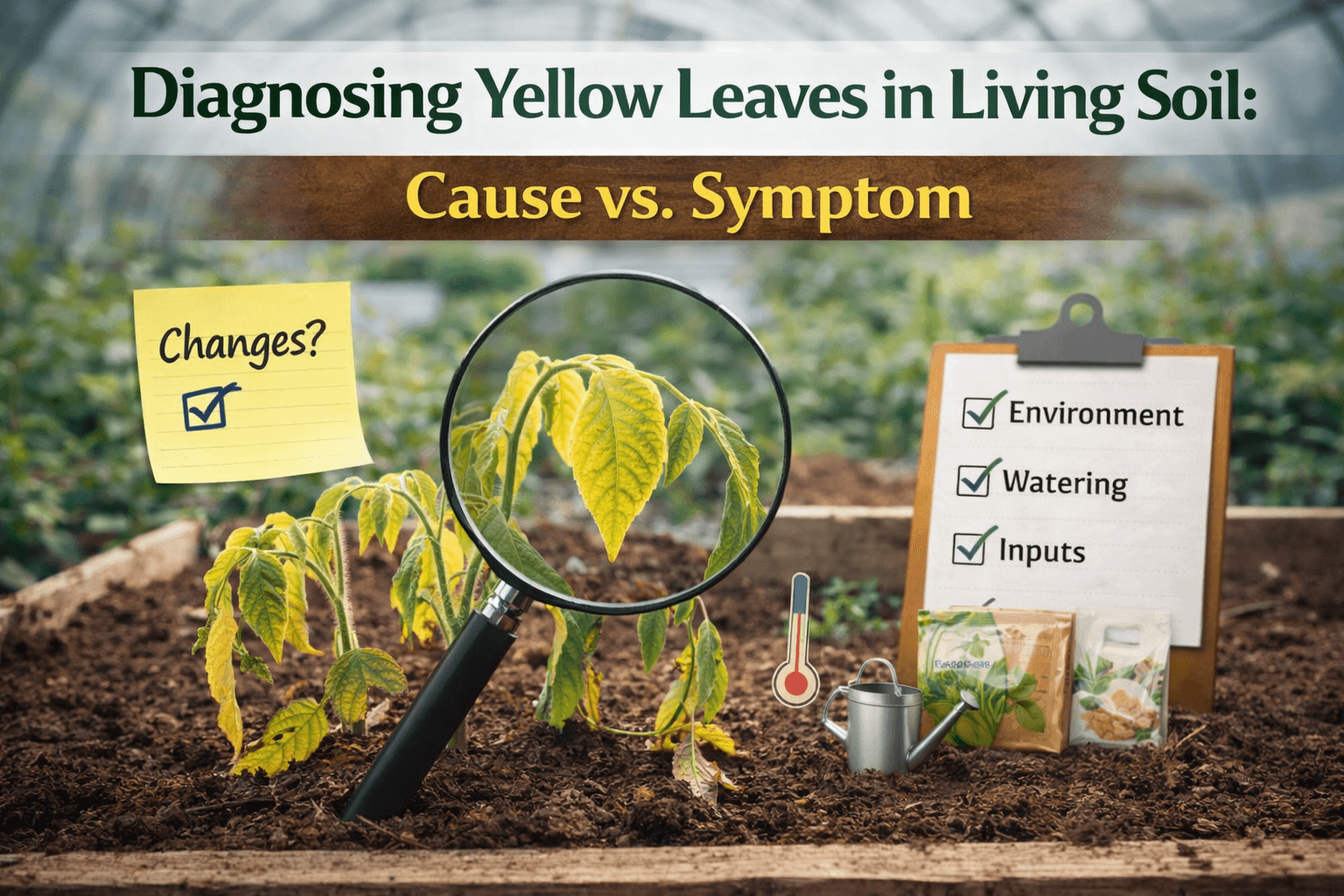
Instead of guessing, we use a structured checklist and flow framework.
Before you try to fix anything, you ask questions.
What changed recently?
Did temperature shift?
Did humidity change?
Did light intensity increase?
Did you transplant?
Did you top dress or add amendments?
Did watering frequency change?
Most plant problems show up shortly after a change. That change is often more important than the color of the leaf.
Step One: Review the Environment
When diagnosing yellow leaves in living soil, the first step is not nutrients. It is environment.
Living soil is biologically active. If temperatures drop too low, biology slows down. If soil stays too wet, oxygen levels fall. If the canopy suddenly receives more light or heat, the plant responds.
Yellowing is often the plant communicating stress from environmental imbalance.
If environment is unstable, adding nutrients will not solve the problem.
Step Two: Evaluate Watering Practices
Watering is one of the biggest variables in any living soil grow.
Overwatering reduces oxygen in the root zone. Underwatering creates dry pockets and inconsistent nutrient uptake.
Both situations can create yellow leaves.
Before assuming deficiency, look at moisture levels. Has the container been staying saturated longer than normal? Has watering frequency changed? Did you recently increase volume?
Water management alone solves more “yellow leaf” issues than most growers realize.
Step Three: Consider Plant Age and Position
Is the yellowing happening only on lower leaves?
Plants naturally shed older foliage as they grow. Lower leaf yellowing can be normal senescence, especially in vigorous growth phases.
Is the yellowing happening on new growth at the top?
That tells a different story.
Location matters. Timing matters. Pattern matters.
Step Four: Review Recent Inputs
Have you recently added a top dress?
Introduced a new amendment?
Changed water source?
Adjusted irrigation strategy?
In living soil, heavy handed inputs can temporarily shift nutrient availability.
More is not always better.
If yellowing appears shortly after a change, that change deserves attention.
Why Random Advice Creates More Problems
When someone posts a yellow leaf online and receives twenty different answers, panic sets in.
The grower begins reacting emotionally. They add nutrients. They change watering. They adjust lights. They top dress. They flush. They introduce multiple new variables all at once.
Now the original problem is buried under new variables.
Diagnosing yellow leaves becomes harder, not easier.
The goal is not speed. The goal is clarity.
Living Soil Is a System, Not a Bottle Program
In a properly built living soil system, severe deficiencies are less common than many believe.
Biology cycles nutrients. Minerals are already present in the soil profile. When yellowing shows up, it is often tied to environmental stress or watering practices rather than a missing element.
This does not mean deficiencies never happen. It means they should not be your first assumption.
How to Ask for Help the Right Way
If you need help diagnosing yellow leaves, provide full context.
- Growing medium
- Container size
- Plant age
- Recent changes
- Watering schedule
- Temperature and humidity
- Light intensity and distance
- Recent amendments
With that information, experienced growers can actually help you think through the problem.
Without it, anyone answering is simply guessing.
Stop Treating Symptoms. Start Identifying Causes.
The leaf is not the problem. It is a signal.
Diagnosing yellow leaves correctly requires stepping back and reviewing the entire system.
What changed? What shifted? What variable moved?
If you slow down and follow a framework instead of chasing charts, you will solve problems faster and create fewer new ones.
Final Thoughts
Social media rewards fast answers. Good growing rewards thoughtful ones.
If you learn how to approach diagnosing yellow leaves through context, environment, and system review, you will outgrow the chaos of random advice.
This is not about memorizing deficiency charts.
This is about learning how to think like a grower.
That is the difference between guessing and diagnosing.
Before you add anything to your soil, download this and work through it.
Free Checklist and Troubleshooting Guide for Living Soil Growers:
The checklist above will walk you through the troubleshooting steps required to solve the cause of your plants leaf issues. I'm confident that once armed with this checklist you will be able to pinpoint what is causing you problems and get some real help. If you find this helpful, please reach out and let us know, we love to hear stories where our guides make a difference. Also if you could please make a comment below or ask any questions you can think of. Thanks!
BuildAVeg: Vegetative Plant Booster by BuildASoil
$28.00
BuildAVeg: Premium Veg Booster 5 of our favorite products in 1 bag which saves time and money After years of requests, we finally created a product for veg that we could get excited about! Designed from our using all of… read more

Rootwise Mycrobe Complete
$30.00
Mycrobe Complete is a dry, full-spectrum soil inoculant. Twenty species of beneficial bacteria, mycorrhizae, and fungi in one bag. You mix a very small dose into water and drench the root zone, whether you are firing up a brand new… read more

Organics Alive V-TR Dry Soluble Transition Formula
$19.60
$28.00
BuildASoil is permanently discontinuing the Organics Alive line. ALL SALES FINAL 60lb Bags are paid shipping Clearance. Independent lab testing returned inconsistent results, and many numbers did not meet the guaranteed analysis on the label. We commissioned independent laboratory testing… read more

FAQs
What causes yellow leaves in living soil?
Yellow leaves in living soil are most often caused by environmental stress or watering issues rather than a true nutrient deficiency. Sudden changes in temperature, humidity, light intensity, or soil moisture can all create yellowing before a mineral imbalance is ever the problem
Can you diagnose yellow leaves from a photo?
Not reliably. A single photo of a yellow leaf does not provide enough context. Proper diagnosis requires information about environment, watering practices, plant age, recent changes, and soil inputs.
Are yellow leaves always a nitrogen deficiency?
No. While lower leaf yellowing can sometimes be related to nitrogen, it can also be caused by overwatering, root stress, environmental shifts, or natural aging. Jumping straight to nitrogen without reviewing context often creates more problems.
How do I properly diagnose yellow leaves?
Start by reviewing what changed recently. Look at temperature, humidity, light intensity, watering frequency, and recent amendments. Then evaluate where the yellowing is occurring on the plant and how quickly it developed. Diagnosis starts with system review, not symptom matching.
Is it normal for lower leaves to turn yellow?
Yes. As plants mature, older lower leaves may yellow and drop naturally. This is part of normal plant development and is not always a sign of deficiency.
Should I add nutrients when I see yellow leaves?
Not immediately. Adding nutrients without understanding the root cause can create new imbalances. First stabilize environment and watering. Only consider additional inputs after reviewing the full system. Consider Foliar Sprays for diagnosis.
Why does social media advice about yellow leaves vary so much?
Because many responses are based on pattern recognition without context. Multiple issues can look similar visually. Without full information, most answers are educated guesses.
What information should I provide when asking for help?
Include your growing medium, container size, plant age, watering schedule, temperature and humidity, light intensity and distance, and any recent changes or amendments. Context is what makes accurate diagnosis possible.