Table of Contents
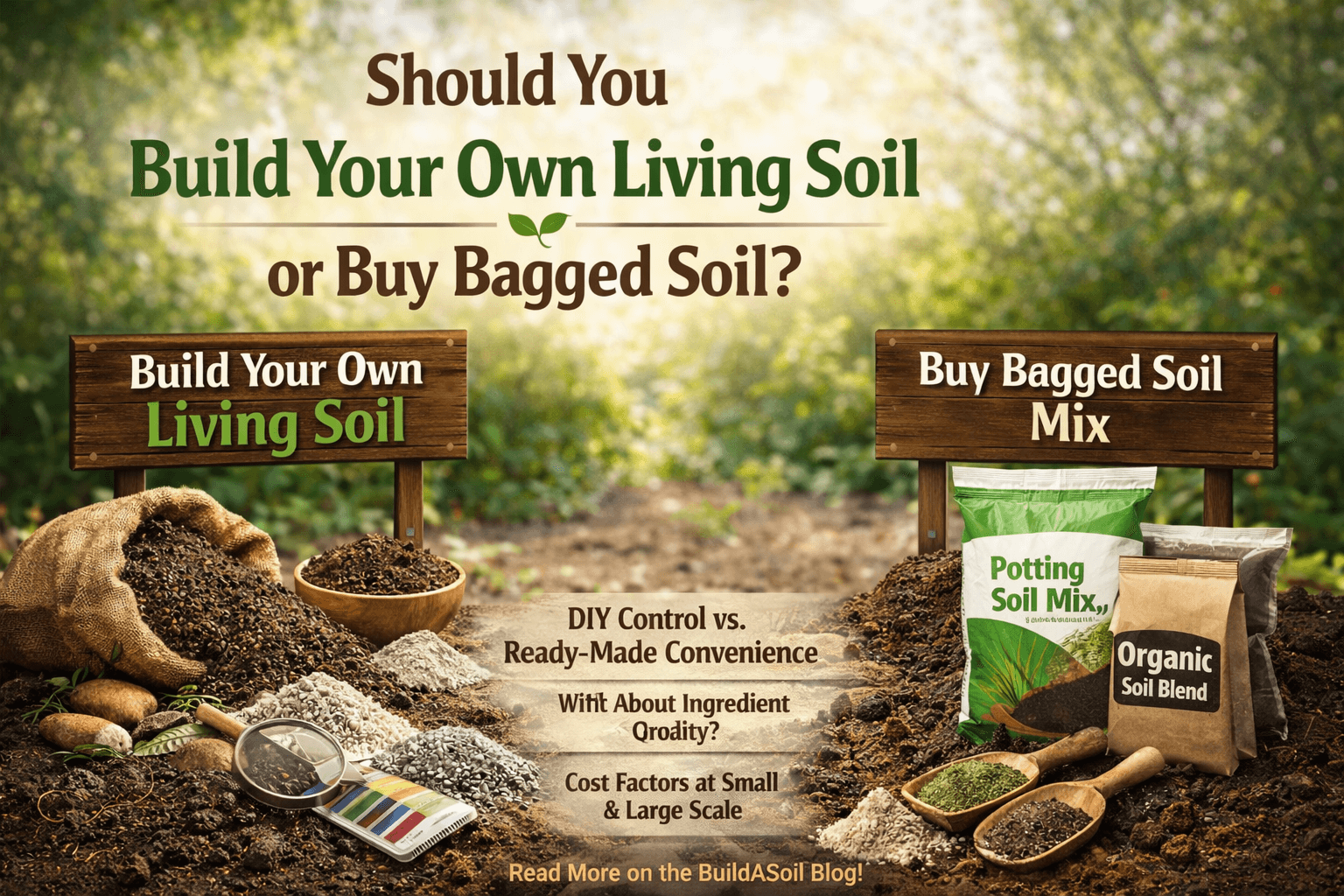
Should You Build Your Own Living Soil or Buy Bagged Soil?
If you're getting into living organic growing, you've probably wondered whether you should build your own living soil or use a professionally blended bagged mix.
This question comes up constantly in our Fundamentals series because growers want to know if making soil from scratch is better, cheaper, or more effective than starting with a ready to use product.
The truth is that deciding whether to build your own living soil depends on your experience level, your access to high quality ingredients, your scale, and how much responsibility you want to take on in the formulation process.
What Are We Actually Comparing?
On one side, you have a fully crafted living organic soil recipe built from raw ingredients like compost, worm castings, peat or sphagnum moss, aeration material, mineral amendments, seed meals, rock dusts, and carefully balanced calcium and phosphorus sources.
On the other side, you have a finished bagged soil that has already been blended and packaged for convenience.
Both approaches can grow exceptional plants. The difference comes down to control, cost, time investment, and knowledge.
The Chef Analogy 🍳
Think of building soil like cooking for someone you care about.
You could source every raw ingredient yourself and build the meal from the ground up. Or you could buy something that has already been prepared for you.
When growers decide to build your own living soil, they are choosing full control over each ingredient and each ratio.
That is the pinnacle. But it requires skill, testing, and patience.
What Does It Really Mean to Build Your Own Living Soil?
When someone says they want to build your own living soil, what they usually mean is sourcing each ingredient individually and blending a complete, biologically active growing medium from scratch.
This includes selecting compost that is fully matured, choosing worm castings rich in microbial life, dialing in aeration for proper oxygen exchange, and balancing mineral inputs so calcium, phosphorus, potassium, and trace elements work together.
The appeal of building your own living soil is customization. You control the compost source. You determine mineral levels. You decide how aggressive or mild the mix should be.
But that level of control also means you are responsible for every mistake.
The Hidden Complexity of DIY Soil ⚖️
Living soil is not simply mixing organic inputs together. It is about biological balance and mineral harmony.
Important questions include:
- Is the compost fully finished and stable?
- Has it been tested for heavy metals?
- Do you know the nutrient profile?
- What is the carbon to nitrogen ratio?
- Are mineral amendments balanced intentionally?
Lack of phosphorus, excess potassium, all of this can interfere with other nutrients. Improper calcium balance can affect structure and nutrient uptake. Immature compost can stall plant growth.
These are common risks when growers attempt to build your own living soil without lab testing and experience.
The Reality of Most Bagged Soils 🏭
Here is something that often goes unspoken.
Most soil companies are not set up to truly manufacture living soil the way it is done at home. They are built for speed and volume. They are not designed to properly cycle heavy mineral inputs, cook soil in batches, or mix material multiple times for uniform distribution.
Authentic living organic soil requires time, space, heavier equipment, and a willingness to work with dense mineral amendments that many facilities simply are not structured to handle.
We built our entire setup around this process. Our systems were customized so we could blend, cycle, and rework soil the same way a serious home grower would, just at scale. That means mixing thoroughly, allowing proper stabilization time, and working with the heavier inputs that make real mineralized living soil perform.
Many bagged soils on the market are not doing this. That is why they often behave more like lightly amended potting mixes rather than true living organic systems.
This is also why we recommend one of two paths. Either build your own living soil from scratch and commit to doing it properly, or use a professionally formulated living soil from a company that is actually structured to do it correctly.
Cost Considerations 💰
At small scale, building your own mix can cost more once you factor in bulk amendment minimums, shipping, and testing. This can be offset with access to local premium compost or better yet, learn to make your own if you have the time and space! I recommend trying Charles Wilber's world record tomato compost recipe using your own local inputs.
At larger scale, the conversation shifts from ingredient cost to operational efficiency.
Commercial cultivation already requires managing staffing, compliance, irrigation systems, environmental control, genetics, pest management, harvesting, and distribution. Soil formulation does not need to become another risk variable.
What About Commercial Scale?
Many assume that once they scale up, they should automatically build your own living soil in house.
In reality, many professional operators are better served by focusing on cultivation while partnering with soil specialists for consistency and reliability.
That is exactly why we developed our commercial recipe called Ultra Clean. It is a professionally balanced living soil designed specifically for large scale production where cleanliness, mineral precision, and repeatable performance matter.
Instead of sourcing dozens of inputs, managing cook times, and testing compost batches internally, facilities can integrate a proven system and focus on dialing environment and plant health.
For many commercial growers, the most profitable move is eliminating unnecessary complexity and working with experts.
Cook Time vs Ready to Use
When blending raw ingredients, soil needs time to stabilize.
Coots old trick was to work all of his amendments through his worm bin first. After the worms are done, then everything is stabilized and he could mix his soil up and plant into it the same day. As this lore has been spread around, many have copied this method and it works very well!! Others have reported that using a proven compost source, you can follow coots recipe without any cook time... But when you are new, it's always best to test by waiting and making sure it's not getting hot.
This allows microbial populations to establish and amendments to begin breaking down into plant available forms.
Skipping this phase can lead to unstable soil and inconsistent performance.
A properly manufactured living soil has already gone through this stabilization process before it reaches you. Most every potting soil on the market is mixed and bagged all within seconds..... no cook time.
Best Practices Either Way
- Prioritize compost quality above everything else
- Maintain proper calcium balance - when calcium is right everything else is easier.
- Use diverse trace mineral inputs
- Allow soil time to stabilize
- Master your watering practices
Soil is a living system, not just a recipe. Whether you choose to build your own living soil or use a professionally crafted blend, understanding biology and mineral relationships is what ultimately drives success.
Final Thoughts
Making your own soil from scratch is the pinnacle. It gives you total control and deep understanding of the system.
But it is not always feasible.
If you are not prepared to source high quality ingredients, test materials, and cycle soil properly, then it makes more sense to use a living soil from a company that has built its entire operation around doing it correctly.
Ultimately, the goal is the same. Healthy soil biology, balanced minerals, and thriving plants.
Learn the principles. Commit to the process. Grow with intention.
Here is a link to a free report on making your own Complete Organic Fertilizer as recommended for Soil Building.
Check out our Compost Section if you want premium compost.
BuildASoil Complete Soil Building Kit - Coot Approved
$93.60
$104.00
Complete Soil Building Kit The Clackamas Coot recipe, in two bags Everything that turns peat, aeration, and compost into a living soil: the Nutrient Kit and the Mineral Kit, sized to your bale. You bring the base, mix it once,… read more

BuildASoil Potting Soil Recipe 3.0
$55.00
Made with the water-only grower in mind. No bottled liquid nutrients. Give it enough pot and the soil carries the plant. Composted 10–30 days and twice-mixed before it's bagged. Reusable. Reamend between runs and it gets better every cycle. Independent… read more

Bulk BuildASoil Ultra Clean Commercial Recipe
$430.00
Commercial Living Soil The soil serious commercial growers standardize on. Low heavy metals is just the price of entry. Ultra Clean clears that bar and then goes further: it is our best-testing, best-producing recipe, built from the ground up for… read more

FAQs
Is it better to build your own living soil or buy bagged soil?
It depends on your experience and goals. Beginners often benefit from buying a professionally blended living soil because it removes guesswork and reduces risk. That being said, beginners that follow a proven recipe and have access to premium compost can succeed easily. Experienced growers who understand mineral balancing and compost quality may prefer building their own for greater control and customization.
Is building your own living soil cheaper?
it can be!!! No matter what, if you learn to supplement your recipe with local inputs you can save piles of money, it's just that most people will end up having to ship most supplies and that is cost prohibitive. At small scale, building your own soil can actually cost more once you factor in bulk amendment purchases, shipping, testing, and time.
Do you have to “cook” living soil?
Short answer... If you build soil from raw ingredients, yes.
Longer answer... Cook time allows microbial populations to establish and amendments to begin breaking down. Skipping this step can lead to nutrient imbalances or overly “hot” soil. Following a recipe like coots recipe on smaller scale, you can skip the cooking phase but the sure way to be safe is to mix your soil and let rest to see if it gets hot in the center. If it does, you will have to turn it and keep doing that daily until it stops getting warm, then lest rest several more days to be sure and then it's time to use the soil. BuildASoil goes to great length to mix soil, let it cook in bulk volume and then mix it again and rebalance moisture prior to bagging.
Can I start with bagged soil and add my own amendments?
Yes, but..... The Living Organic Soil movement is one that recommends starting from scratch whenever possible. The super soil recipes and old school home grow recipes often recommended a base bagged potting soil because this was something you could do easily anywhere in the country during prohibition era. Now that we can all communicate it's clear that making your own soil from scratch is the goal. If you can't do that, justy grab some BuildASoil! Either way, you can still use a base soil, I just wanted to share why we don't often recommend that method. Many growers begin with a quality base mix and customize from there. This approach offers a balance between convenience and control, especially once you understand how specific amendments affect mineral balance and biology.
What ingredients are essential in a living organic soil recipe?
A complete living soil typically includes
15-35% high-quality compost anr/or worm castings
30-50% Canadian Sphagnum Peatmoss
30-40% aeration material like pumice and rice hulls
To this a complete organic fertilizer amendment pack is added
Seed meal, Various calcium and phosphorus sources, trace minerals like kelp and rock dust, and sometimes extras like insect frass and other organic meals.
What’s the biggest mistake when building your own soil?
The most common mistake is ignoring ingredient quality and balance. Poor compost, untested inputs, or randomly adding amendments without understanding mineral ratios can create long-term issues in plant health and soil biology.